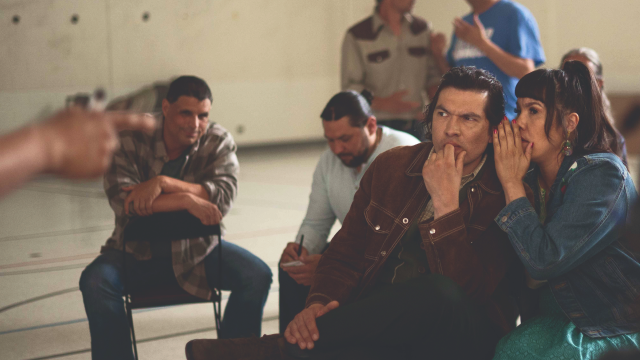
A new database for Canadian films makes it easier for independent cinemas to find and exhibit them. It’s a NICE idea
It’s tough out there for an independent cinema. Theatre going dropped off a cliff during the pandemic, and with the rise of films on streaming services, it’s never fully recovered. The country’s theatrical market is also one of the most consolidated in the world; in 2024, Cineplex accounted for 73 per cent of Canada’s box office share. Compare that figure to the US, the UK and Australia, where a single theatre chain has captured no more than 30 per cent of the market.
It’s equally tough out there for an independent film. “Theatrically, not that many films are finding audiences, period,” says Andy Willick, who owns two independent cinemas: the ByTowne Cinema in Ottawa and the Fox Theatre in Toronto. “A lot of small films are getting lost. For Canadian films, it’s that much more difficult.” Independent producers know this all too well and have to hustle harder than ever to get their projects seen on the big screen.
Take the 2024 movie Paying for It (Hawkeye Pictures, Wildling Pictures), based on Canadian cartoonist Chester Brown’s graphic novel about his experiences with sex workers. The producers used a DIY, slow-release micro-distribution model for the film: travelling from city to city, screening in independent cinemas, festival venues and some multiplexes, with director Sook-Yin Lee, Brown and cast presences as an added draw. Nearly nine months after its theatrical release, the movie is still being booked and filling venues.
In order to locate and get in touch with independent cinemas, the film’s producers worked with the Network of Independent Cinema Exhibitors (NICE), a group of indie cinemas across the country. NICE represents everything from “retro summer drive-ins to beautiful old heritage buildings to downtown art houses,” says Sonya Yokota William, NICE’s director.
“Independent cinemas in Canada have really come together, and we have a strong culture of supporting each other. We meet once a month on Zoom to talk about the state of the industry and our concerns, everything from building insurance to people throwing things at the screen during Minecraft movies,” says William.
NICE also has an active message board, one on which members are often asking where a certain film can be found, or who holds the rights. “Through my access to the message board, I noticed that theatre owners had really amazing ideas about, say, bringing out an old title to celebrate a special anniversary,” says Hawkeye’s Aeschylus Poulos. “Sometimes, that information wasn’t easy for them to track down.”
Enter NICE’s new Canadian Theatrical Marketplace: a digital database of Canadian films (marketplace.nicecinema.ca) that connects independent cinemas with their rightsholders (typically producers). With searchable categories like genre, theme, screening format, accessibility features and so on, rightsholders are responsible for uploading information about their own films.
“It’s not IMDb. It’s not run by Google or Amazon. It’s the filmmakers, the producers and the Canadian distributors themselves providing the information to keep these films alive. It’s like a digital Great Library of Alexandria for Canadian film.”
Hot Docs Ted Rogers Cinema, Photo by Gabriel Li
“There’s no central place where exhibitors can go to find out what Canadian films are out there, and the Canadian Theatrical Marketplace will fill that gap,” says William.
Cinema owner Willick is optimistic about the tool. “I think it could very well help us fill in holes in our programming, and to find films from different cultural communities and geographical areas more easily,” he says. “I hear from my peers across Canada that some of their most successful films are, for example, documentaries from someone who’s from their hometown. So if I can actually go into the database and find a doc that’s specific to where I’m located, that could work really well for both filmmakers and for theatres, because we’re connecting more directly.”
That direct connection is what independent cinemas do best. They often have deep roots and long histories in their towns, helping owners understand what plays well with their customers. From his experience with Paying for It, Poulos observes that “the people who own these theatres really know their audience and community.”
He contrasts this to the big players, which tend to only play movies with broad commercial appeal. “You go to a multiplex, and there are five to 10 films, and they’re often kid movies or action movies. They’re not necessarily thinking about their community and their local audience,” he says. “I think this database—having access to these Canadian stories—will really give rise to an opportunity for more films to get out there and find their audience.”
There are also plenty of other ways the database could be helpful. William plans to add a “curatorial aspect,” selecting and showcasing films that might be suitable for, say, an upcoming holiday or commemorative occasion. She also imagines it being used by exhibitors (or any other interested individual) in other countries “who want to explore the Canadian film landscape. Having one central place that people can look for films seems like a natural solution.”
Willick envisions an educational extension, where university professors use the database to find Canadian films that they can play in class. He also believes there’s a possibility streaming services might find it helpful for populating their catalogues with regional content: “You never know: streamers could go in and say, ‘We need some films from this area,’ or ‘We need this type of film,’ locate it, and contact the producer.”
Whatever the database evolves into or whoever uses it down the road, it’s significant that it’s laying the foundation for an even stronger partnership between cinemas and producers, who have every reason to stick together.
“It’s not IMDb. It’s not run by Google or Amazon. It’s the filmmakers, the producers and the Canadian distributors themselves providing the information to keep these films alive,” says Poulos. “It’s like a digital Great Library of Alexandria for Canadian film. I can’t believe it didn’t already exist.”
Read more indiescreen
Strong signals
The CMPA’s Reynolds Mastin in conversation with CBC/Radio-Canada’s Marie-Philippe Bouchard
Honouring the environmental, professional and personal impact of Tracey Friesen
In January 2025, we were heartbroken to lose Tracey Friesen, an industry luminary, sustainability advocate and beloved friend. The managing president of the CMPA’s BC branch since 2020, Tracey embodied commitment to social and environmental justice. She also embodied optimism. Her belief in the power of connection—and her extraordinary gift for collaboration—directly and indirectly set in motion countless initiatives for good within Canada’s screen industry.
We recently gathered some of her industry co-collaborators, colleagues and admirers (with Tracey, none of these categories were mutually exclusive) to reflect on how Tracey’s friendship, guidance and shining example continue to propel their own work forward.
Liz Shorten Chief Operating Officer, CMPA
Elisa Suppa Manager, ESG and Sustainability, Telefilm Canada
Anne-Valérie Tremblay Manager, Funding and Member Services, L’Association québécoise de la production médiatique (AQPM)
Lisa Clarkson Executive Director, Business & Rights and Production Sustainability, CBC; Chair and Founder, Canadian Broadcasters for Sustainability and Green Frame
Marsha Newbery VP, Sustainability & Business Affairs, Thunderbird Entertainment; Executive Director and Founder, Producing for the Planet
How did each of you meet Tracey?
Liz Shorten: I met Tracey probably 25 years ago, when I was at BC Film and she was working for Rainmaker, which was a post-production facility at the time. I remember meeting her at an industry meeting, and just going, “Who is this woman? She’s amazing.” At her request, I later became the first board chair of her charity, Story Money Impact (see page 50). I couldn’t say no to Tracey.
Elisa Suppa: I met Tracey just a few years back, when Telefilm really started to engage on the priority of sustainability, through [former CMPA and Canada Media Fund executive and current Bell Fund executive director] Marcia Douglas. Very soon after meeting—on Tracey’s impetus—we started finding ways to work together. And she really was quite a dynamic force who incited action in a very constructive way.
Anne-Valérie Tremblay: I met Tracey at the beginning of 2024, because I’m also in charge of sustainability initiatives at the AQPM. Tracey reached out to me so I could share what we were doing here in Quebec. But instantly there was a connection. She’s so nice and so open, and she wanted to see if we could work together to amplify our efforts. Immediately, she felt to me like a people person who knew how to make things happen. She was so good at unifying people.
Lisa Clarkson: I met Tracey, I believe, at Prime Time [CMPA’s yearly media conference] in 2022. It was Liz who said to me, “You need to meet Tracey Friesen.” And we immediately connected. We sat at one of those round tables in the hall and compared notes. And we agreed that the CMPA would partner with the CBC around a green storytelling work- shop-type thing. That was in February. We launched the workshops in April. They happened in June. I’d say the truest aspect of Tracey was that she was exceptional at action through connection.
“Right from the minute that we connected, all we talked about was what was possible. Not what made it impossible, but what was possible. Not ‘No, this can’t be done,’ but ‘Here’s how it can be done.’”
Marsha Newbery: I think I must have met Tracey in the early 2000s, when I was starting out as a baby producer and she was at the NFB. I had a couple of small projects with the NFB, and then it was just one of those things: you’re in the community, you see each other all the time. But I really got to know her when I worked at the CMPA and she came on. I worked very closely with her for two or three years at the CMPA. We continued working together, specifically on sustainability, when I took on a sustainability job at Thunderbird and then launched Producing for the Planet.
Liz, you were Tracey’s supervisor at the CMPA. How did she shape sustainability initiatives there?
Liz Shorten: Tracey was the perfect person for this file, because of her passion and her experience. As folks have already said, Tracey was a connector. She also was somebody who believed in action, and she did that through collaboration. And amazing things happened over the course of a couple of years because she just took charge.
A number of years ago, the CMPA board of directors decided to create a sustainability and climate action committee. This was big. It signalled that the board was going to make sustainability a priority. And it became Tracey’s thing. Each CMPA committee has a staff lead, and Tracey was that staff lead. And the work of the committee, the budget, everything—it was her creation. And the committee has supported all of the CMPA’s work to date on the climate file.
The rest of you, how did Tracey inspire the sustainability work you did within your respective organizations?
Lisa Clarkson: I will tell you: I’m old. And I have never encountered such a challenging initiative as sustainability in our industry. There is such a wide variety of attitudes and approaches, and sometimes resistance. It’s actually very, very, very hard to get things done.
How did Tracey inspire me? Right from the minute that we connected all we talked about was what was possible. Not what made it impossible, but what was possible. All of her work—green storytelling, innovative work on environmental sustainability, costing—all was done with a possibilist perspective. Not “No, this can’t be done,” but “Here’s how it can be done.”
In this work, there are so many people who are so ready to say no. But so many projects—whether or not she was involved in them directly—she just made me think that they were possible. And I’m sure that was part of the reason I thought that I could pull off Canadian Broadcasters for Sustainability [a coalition of broadcasters committed to sustainable change] and start Green Frame [a coalition of Crown corporations, federally funded organizations and CRTC-mandated funds committed to increasing sustainability in the industry]. She gave me the confidence to say, “Well, maybe collaboration will work.”
Marsha Newbery: When I was at the CMPA, we were just coming out of COVID, we were having heat domes and wildfire season in Vancouver, and I said to her, “I really want to get more into sustainability.” And she supported me taking some training, and she championed me to get into sustainability even more. I don’t think I would even be on this path without her support. That was a good boss moment.
And she was also the first person I called when I was thinking about setting up Producing for the Planet [a non-profit that formalizes independent Canadian producers’ commitments to climate action]. I asked her, “What do you think of this crazy idea?” And I’m not going to lie, she asked some very challenging questions. But it was all to make sure there was a real chance of success. I knew she would tell me it was crazy, and then we would work it out, and she would have my back. That was my experience of her.
Anne-Valérie Tremblay: I remember, after one of the conversations that we had, I realized that Tracey was not only in charge of sustainability, like I was: in her case, her whole person was about sustainability. And I thought, “Well, Anne-Valérie, now you have to step up, because Tracey is not only in charge of sustainability, she’s living it.” She inspired me to embrace the values, because she embodied them.
Elisa Suppa: One small example of Tracey’s influence: when Telefilm launched our sustainability budget template, as soon as Tracey got wind of it, she said, “How can we get it into the hands of our producers?” So she quickly organized and recorded these training sessions. She always wanted to get the information out to help other storytellers.
And what I saw in our meetings was that she raised the comfort level, even when there wasn’t comfort to begin with. When she first started the “sirens meetings,” as we eventually called them, I thought, “What’s this going to be?” And then you realize that she was really creating—I think we all felt it—just a very safe space to say what we thought.
A lasting impact
Over her decades-long career, Tracey Friesen performed many different roles, from executive producer at the NFB to director of communications and engagement at the David Suzuki Foundation. But a role she particularly cherished was founder of Story Money Impact (SMI), a non-profit that assists documentary filmmakers in their efforts to spark social and environmental change through their films. This organization carried on the work Tracey began in her 2016 book Story Money Impact: Funding Media for Social Change. Following Tracey’s passing, SMI announced the creation of the Tracey Friesen Impact Fund, which will provide financial support to social and environmental justice projects and their makers. Such a fund had long been a dream of Tracey’s, and will be an enduring testament to her belief in storytelling’s power. To learn more and to donate to the fund, please visit storymoneyimpact.com.
Can you share more about “the sirens”—the informal sustainability working group that Tracey created? What was her intention with that group?
Lisa Clarkson: It was all her. Initially, I was honestly skeptical about it. I thought, “Who needs another meeting? No, thanks.” But I did it because it was Tracey, and she saw the possibility, so I wanted to see the possibility, too. She wanted to gather people that she believed to be influencers in the sustainability space, so that we could hack through some of those really difficult sustainability challenges and problem solve.
And I have to say it was massively effective to share unvarnished thoughts and get unvarnished feedback. There are so few places in our industry to do that.
Elisa Suppa: At first when she called the group the sirens, I think we all laughed, because of the mythological connotations. But once I understood the vision she had, it made sense. It became clear that she was putting together a sort of tiny think tank—what she called “watchers for the future.” Where do we need to go? How can we bring others along?
Anne-Valérie Tremblay: Yes, and “sirens” also has this double connotation, both of mythology and of sounding an alarm. And every time I would tell my colleagues, “I have a meeting with the sirens,” they would start laughing. But it was such a good meeting!
What do you feel Tracey has left you with as you continue the fight? What of her legacy would you want others to carry with them?
Elisa Suppa: It’s hard to think of just one thing to say. If producers or storytellers can do even one thing, any step, however small, is important. And eventually the tide will change. She made it clear that nothing was too small or too big.
Marsha Newbery: Working in sustainability can be very hard. And, near the end of our time together, Tracey expressed some of that hardness that she was feeling. And the last conversation I had with her, where she knew it was probably the last time we were going to be talking, she just said, “It doesn’t matter how hard it is. You have to keep fighting. Just never give up. Never give up. Never give up.”
And that is the piece of Tracey I carry with me every day.
Read more indiescreen
Strong signals
The CMPA’s Reynolds Mastin in conversation with CBC/Radio-Canada’s Marie-Philippe Bouchard
The CMPA’s Reynolds Mastin in conversation with CBC/Radio-Canada’s Marie-Philippe Bouchard
Marie-Philippe Bouchard took the helm as president and CEO of CBC/Radio-Canada early this year, at a time when all eyes were on the public broadcaster and its future as a bastion of cultural sovereignty. Bouchard came to the role with a wealth of broadcasting experience, prepared to steer the ship through whatever storms may be looming.
As representative of hundreds of independent Canadian producers, the CMPA’s president and CEO, Reynolds Mastin, has his own questions for Bouchard—around new financing models for CBC series, the shrinking kids’ market, the centrality of IP ownership in the definition of Canadian content, and more. Here, the two leaders discuss what’s on the industry’s mind.
Reynolds Mastin: You spent the majority of your career at CBC/Radio-Canada. Then you went on to become the CEO of the broadcaster TV5 Québec Canada. So you came into this role with both an insider and an outsider perspective. Was this job what you expected, based on those experiences, or have you been surprised?
Marie-Philippe Bouchard: You’re right, I was very much a child of the organization. And working across French and English services gave me an overview of the whole landscape. What I expected to find when I started this job, considering the very polarized climate around the financing of CBC, was an embattled group that had been subject to a lot of criticism. In the early days of my tenure, listening to different groups and visiting our regional stations out west, I was comforted by the many voices who were supportive of what CBC was doing.
There are also criticisms about the service that we provide. That largely stems from the fact that we have been subject to many, many reductions of funds over the years. Also, the market has changed so much. Both English and French audiences are flooded with content. How do you make the distinctive Canadian experience stand out? That’s something that we’re all working and striving for.
Anna Lambe as Siaja in North of North (Red Marrow Media, Northwood Entertainment)
RM: On that topic, I want to discuss the North of North model, where CBC, Netflix, APTN and producers came together to make that show. The series has been very successful, both critically and in terms of audience. Obviously a player like Netflix brings financing to the table, but they also have that global reach. Is this a model you plan to continue using in the future?
MB: North of North is a good example, but it’s not isolated. In the last few years, we’ve been working with partners—sometimes with the foreign streamers, but also with foreign distributors and foreign broadcasters—to make quality Canadian content that will resonate with Canadians, but can also reach wider international audiences. There need to be many players at the table for that to happen.
Really, what a public broadcaster does is work with producers who have the idea and creative talent, and develop that idea for its potential. We invest. We take the risk. We greenlight the project. But we know we need more money at the table, as well as more creative input. Foreign distributors and other public broadcasters lend a perspective that enriches the production. Together, we have an opportunity to bring to light these incredible shows—but it takes many at the table. In the English market, at least, we can get that influx of funds from a partner like Netflix. That model also means figuring out how we’re going to share those rights, especially with foreign streamers that are very much present in Canada.
In the case of North of North, I want to point out that before we entered into the Netflix deal, we partnered with APTN. And that is very important: we can partner with Canadian broadcasters and share some of those rights, and this allows everybody to be able to bring their touch to the project and also to reach their particular audiences.
RM: How do you ensure that you’re preserving that distinct Canadian voice, while the streaming service brings its own creative input and is thinking about an audience that goes well beyond Canada?
“Our philosophy is to work very closely with the producers to enable the original Canadian creative process, and to support the development of the project so that it will have legs.”
Marie-Philippe Bouchard, President and CEO of CBC/Radio-Canada
MB: Our philosophy is to work very closely with the producers to enable the original Canadian creative process, and to support the development of the project so that it will have legs. The project will be able to not only reach Canadian audiences and satisfy them, but also have a potential to showcase what Canadians can do and their creativity. That’s our part, and we enable that with funds, with advice, and with risk-taking.
RM: That’s one of the things that CBC has in common with producers: taking risks. Part of the reason producers take those risks is that they expect to be able to monetize the IP they create, which allows them to reinvest in development and make the next piece of IP. Throughout the CRTC hearings on the Online Streaming Act, we talked a lot about the importance of Canadian IP ownership. What are your thoughts on the importance of that as one of the pillars of our modernized system?
MB: CBC has been entirely consistent in saying, very loud and clear, that Canadian content is produced by Canadians and owned by Canadians. It can include all sorts of stories, it can be about all sorts of things, but the nature of it is that the IP is owned by Canadians, and it was produced in the key functions by Canadians. That’s the best and most stable way to define it.
It’s also the most sustainable way. Because we do understand that producers take risks, and they are counting on some financial upside to the life of the production over time. So we continue to need viable independent producers in Canada to be able to continue our work. The best way for that to happen is to place serious protection around the notion that the privileges of Canadian content will be awarded to those who are Canadian, and own the content.
Reynolds Mastin, Prime Time 2025
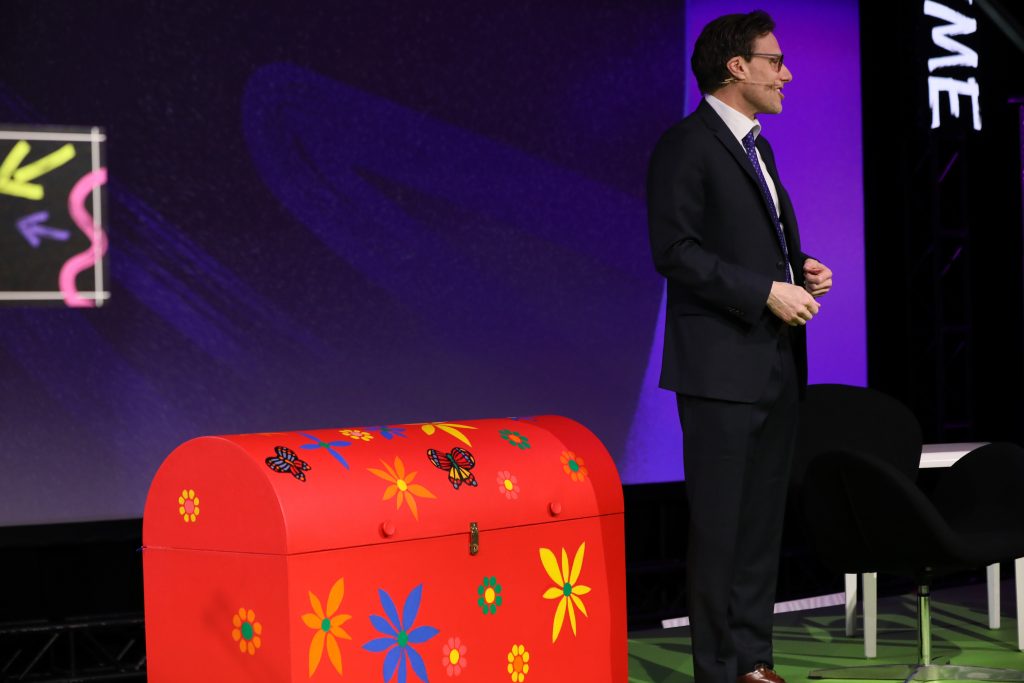
RM: Let’s discuss the state of kids’ content. I remember, in my opening remarks at Prime Time 2024, I had a special guest star, and it was the tickle trunk from Mr. Dressup. A year and a half later, people still come up to me to talk about the tickle trunk. It speaks to the power and importance of children’s content, because Mr. Dressup was clearly integral to people’s childhoods growing up. They have a very powerful emotional attachment to that show and to everything about that show.
As you know, we’re experiencing crisis in the kids’ industry at the moment. Especially in Canada, it’s under enormous pressure. Going forward, what do you think CBC’s role is in finding a way to rebuild and restore what was once one of the strongest pillars of the domestic content industry for Canada?
MB: Certainly, the kids’ industry was a powerhouse of Canadian content production, for many, many reasons— including the fact that, at that time, kids were watching a lot of conventional TV. They weren’t on TikTok. They weren’t on YouTube. There was a demand for kids’ content and Canadian expertise. But as the cost of animated shows continued to rise, the market sort of dissolved. Kids are now consuming all sorts of things, including programming that wasn’t made for them. We are all nostalgic for how we grew up, attached to safe kids’ programming made for us, compared to how our kids are now growing up.
What is the role of the CBC in all of this? We are, and we continue to be, major contributors for the kids’ sector, because we commission Canadian content. We partner with a lot of foreign broadcasters, usually public broadcasters, to broadcast Canadian content not just here, but around the world. But we can’t solve the contraction in the market all by ourselves.
We can’t change the fact that streamers, for example, are commissioning less kids’ content. But we can be steadfast in what we commission. We may need to work more with other Canadian public service broadcasters, such as the educational services in the various provinces, and across French and English, because many languages can support an animation project. I think we need to widen our partnerships. Our job is also to make sure that kids’ content gets in front of kids’ eyes, and that may mean commissioning content that will maybe find its way onto third-party platforms, under the safe CBC umbrella. We need to reach kids where they are.
RM: I think it’s particularly important, when we’re talking about kids’ programming, to talk about what Canadian kids see in the Canadian programming they watch. I’ve heard you speak elsewhere about the need to ensure that CBC/Radio-Canada’s programming fully reflects the depth and breadth of Canadian society. Can you share those thoughts here?
MB: We really want to tap into the creativity and ability of producers from across the country, and make sure that our content reflects that cultural touch that’s different from the west coast to the east coast to the far north, and everywhere in between. We also need to reflect the communities from a language point of view, particularly minority languages—so our strategy for Indigenous reflection and empowerment is really important from both a cultural and language point of view.
We are very committed to working with producers from all areas and sensibilities, and making sure that they hire talent that reflects that diversity as well. It is really about nation building, right? You feel part of the community when you know your neighbours, including the people who live a little further from where you live. And that is the magic of media: creating bridges between those distances.
This is also true between generations. Our kids and our adolescents and our young adults are thinking things that are not necessarily what their elders are thinking. Each generation needs to understand that. That’s the basis of what a public broadcaster is there for: it’s not to narrowcast, it’s to bring people together.
“Discoverability is part of how we work with producers: making sure that people are aware of the content, that it’s accessible, and that it’s promoted.”
RM: Again, related to the Online Streaming Act, we’ve talked a lot about access to our stories and what that means for Canadian content on online platforms. We’re expecting a CRTC-commissioned study this fall on how Canadians find and discover content. What are your thoughts on the challenges of discoverability?
MB: Discoverability is part of how we work with producers: making sure that people are aware of the content, that it’s accessible, and that it’s promoted. It used to be just the broadcaster’s job, but it really is work we do together with producers now—having key characters present on social media to create hype, for example.
From a regulatory point of view, we also have to have the support to make sure that those platforms that people are finding content on have responsibilities towards Canadian content to make sure that it’s visible. And it’s accessible. And it’s promoted appropriately. We need all of those regulatory tools, and we need those relationships between broadcasters and producers, in order for content to really reach the audience that we want to reach.
RM: My sense from you is that your strategy, at least for certain kinds of shows, may include having content that was commissioned from producers by CBC not only appear on CBC TV or Gem, but also on other platforms where audiences are. Is that a fair comment?
MB: I think we need all of it. We do need a strong core of content available on a platform like CBC Gem, because it is the destination for Canadian content. But the fact of the matter is, there are audiences that basically live on platforms like YouTube and will not be drawn elsewhere. And our responsibility as a public broadcaster is to reach Canadians where they are. We have an awful lot of content available already on YouTube, for instance, just to speak of that platform. We have to go out and reach people where they habitually consume content, because that’s where we can reach them with trusted news. That’s where we can also give them a taste of Canadian comedy, of Canadian drama, of kids’ shows.
RM: Last question—will partnering with independent producers continue to be critically important to CBC/Radio- Canada in fulfilling its mandate for key genres of programming?
MB: It is impossible to imagine anything else. We are the home of Canadian content. Who else is going to produce it with us, for the benefit of Canadians, but independent producers? We know that’s a long-term relationship, and we want to continue to care for it.
Canada’s largest commissioner of original Canadian content
$400 million+ per year investedin independent production across Canada
300+ original TV shows from independent producers every year
80+ shows created for streaming services, including CBC Gem
20 million+ Canadians use CBC/Radio-Canada’s digital services every month
$1.9 billion annual budget
$72.9 billion contributed to the Canadian economy every year
630,000+ jobs provided
45,000 hours of Canadian TV content, including:
10,000 hours of Canadian drama, comedy, and other entertainment
20,000 hours of kids’ content
For every dollar invested in the public broadcaster, two dollars are reinjected into the Canadian economy.
Read more indiescreen
State of the arts
In conversation with the Honourable Steven Guilbeault
Hardworking Canadians are everywhere on our screens: unscripted series set in perilous environments, comedians about manual labourers, a dating show for farmers. What makes these shows so irresistible?
Hardworking Canadians are everywhere on our screens: unscripted series set in perilous environments, comedians about manual labourers, a dating show for farmers. What makes these shows so irresistible?
In our ever-more complicated,automated, outsourced, push-button world, Canadian audiences can’t get enough of shows featuring regular people who roll up their sleeves and get to work. Blame an overly rich diet of prestige, high-concept TV. Blame the pandemic, which revealed to us the vulnerability of supply chains, and how little we know about how our system actually works. Blame anxiety around Al and our longing for a simpler time.
Whatever the cause, viewers are flocking to documentary series featuring risky, high-stakes work, like Northern Air Rescue, East Harbour Heroes and Highway Thru Hell (which has been renewed for a 15th season!). Scripted comedies about blue-collar workers—The Trades and The Office Movers—are gaining traction. And maybe you’ve heard of Farming for Love, a dating show for, yep, farmers.
“The characters and real-life figures resonate with Canadian audiences“
East Harbour Heroes
Justin Stockman, VP of content development and programming at Bell Media certainly understands the appeal of these shows, once joking on a conference panel that if it has a truck, it’ll find an audience. Bell Media is leaning into this with original series such as The Trades, The Office Movers, Farming for Love and Highway Thru Hell, among others. “The characters and real-life figures resonate with Canadian audiences, reflecting viewers’ own experiences and making it easy to connect with the stories,” he says. “Our focus remains on creating original content with humour and heart, content that allows Canadians to see themselves represented and fosters that important and valuable emotional connection.”
Despite their differences in genre and tone, these workplace shows have at least two characteristics in common. One: they’re undeniably authentic, firmly grounded in real life. Two: they have a great big heart.
Farming for Love (Lark Productions, Fremantle)
“These are the people who bring us our food, our beer, our bread”
Farming for Love is probably not the kind of show that springs to mind when you think of a romance reality series. There’s no island. There are no crafty characters. According to producer Tex Antonucci, of BC’s Lark Productions, the company’s goal with the show was to solve a real problem: how can busy single farmers find love?
Farming for Love is based on the UK format Farmer Wants a Wife, which has laid the groundwork for over 200 arriages to date. Lark Productions was impressed by the success rate, which suggested the format cared about building lasting relationships, rather than simply entertainment. “We were excited to make a dating series rooted in authenticity and true, meaningful heart,” says Antonucci.
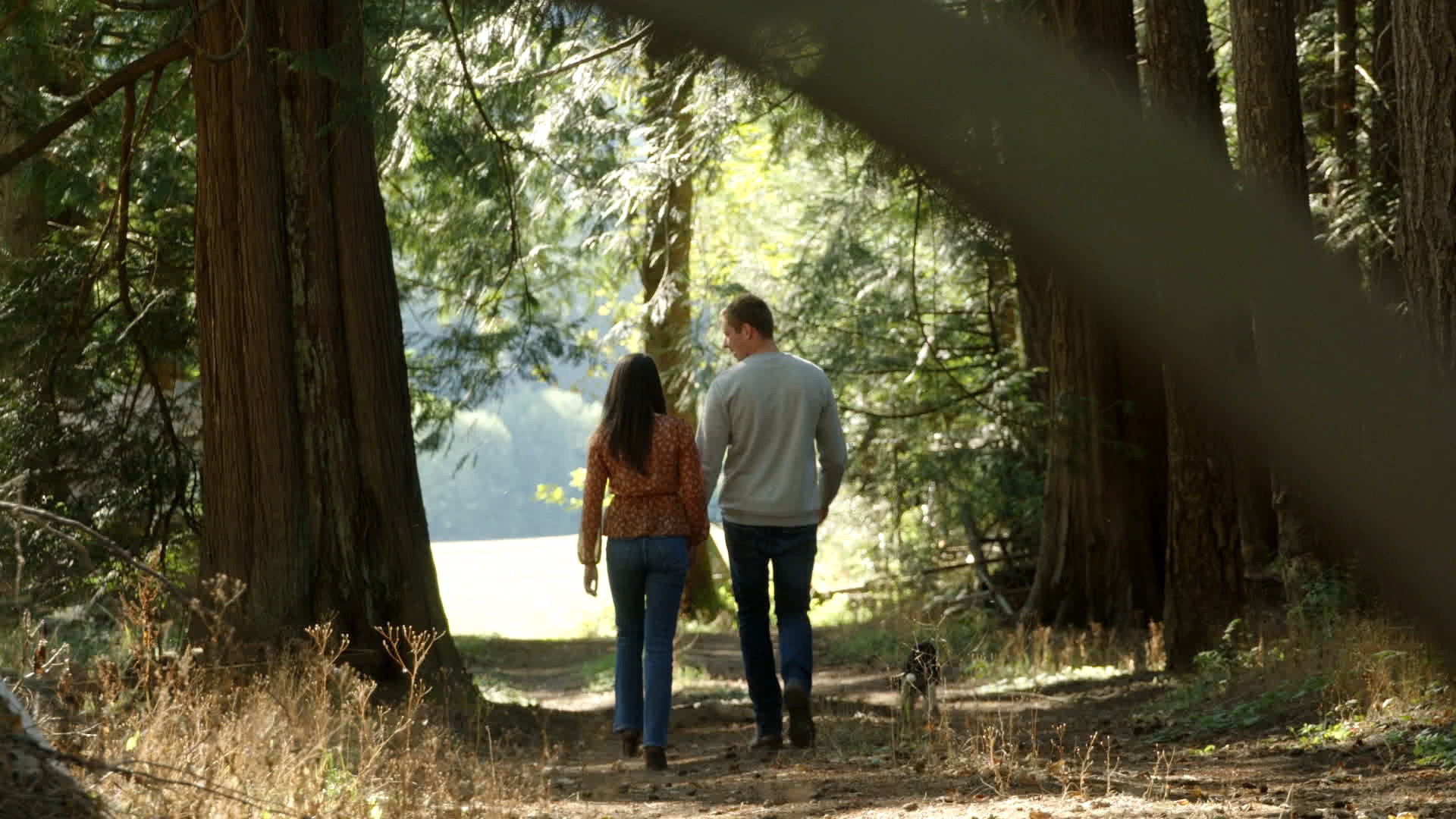
The timing of the show’s release helped draw in audiences. The first season premiered on Crave near the end of COVID, when “we were all romanticizing the idea of leaving the city and living off the land,” says Antonucci. Farming for Love certainly provides the visual fuel for such a fantasy. Antonucci calls the show “a love letter to BC” and its diverse terrain, from desert habitats to lush rainforests.
But the show is just as interested in showing the diversity of Canada’s agricultural industry. That diversity was illustrated in the farmers’ race, sexual orientation, and the type of farming they do: dairy farming, agritourism, winemaking and more.
Tex Antonucci
Says Antonucci, “I think and I hope we helped reframe perceptions of who our farmers are and what they do. At the end of the day, these are the people that bring us our food, our beer, our bread, all these things. It’s cool to shine a light on that.”
“They’re the backbone of our lives, and we don’t always see it”
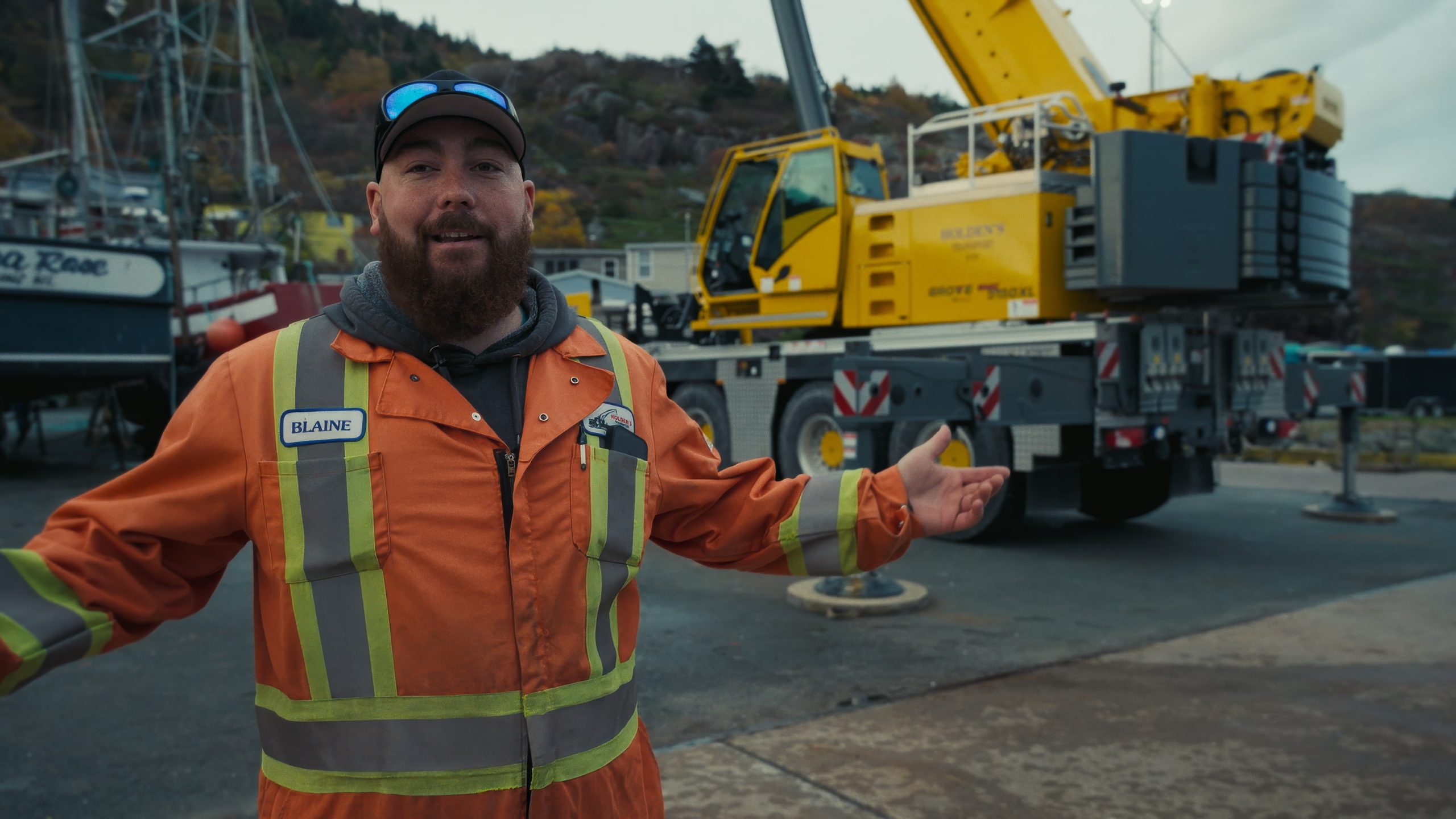
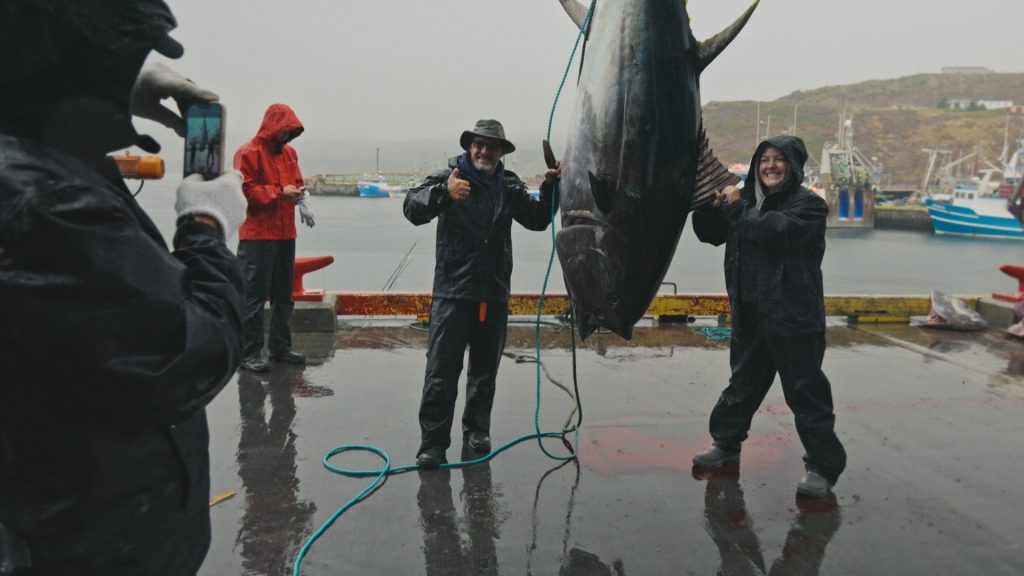
If Farming for Love gives viewers a glimpse of the essential work that farmers do, docuseries offer a front-row seat to types of work that are just as essential, but even more hazardous. East Harbour Heroes (on Crave) follows the workers who “make a living on the edge of the world,” on the coast of Newfoundland, particularly in St. John’s Harbour. “The show is really a look at the everyday heroes that keep communities running,” says Nicole Hamilton, the show’s executive producer and EVP of unscripted content at Attraction.
She defines “everyday heroes” as people whose jobs are nearly invisible to us, but are entirely vital to how we live. The allure of the series—which features stevedores, commercial fishers, tugboat operators and more—lies in both the difficulty of the work and in the characters who do it.
“Mother Nature has her own will and makes things extra challenging,” says Hamilton. Sea ice, hurricane season, winter storms: the show’s cast (not to mention its crew) must contend with all of these things to keep goods moving in and out of the harbour. Even if viewers aren’t ultimately inspired to take up commercial fishing off the coast of Newfoundland, they’re happy to watch from a distance.
Nicole Hamilton
East Harbour Heroes
“Watching these people in conflict with Mother Nature—it’s a powerful battle,” says Hamilton. As is so often the case with docuseries like this one, audiences come for the action and stay for the characters. “The people who do these jobs are so amazing,” says Hamilton. “And Newfoundlanders are so funny. Salt-of-the-earth people. It’s such a special place.”
East Harbour Heroes
East Harbour Heroes is also a story of building local production capacity in Newfoundland. By season three, a full 90 per cent of the crew was local. One of the local camera operators, who started as an assistant, is now the director of photography (DP). Success stories like these have helped the local community embrace the show, which spotlights their often-overlooked livelihoods. “We’re dependent on a certain pool of people to keep our lives running,” says Hamilton. “They’re the backbone of our lives, and we don’t always see it. To shine a light on them is incredibly satisfying.” BC-based prodco Great Pacific Media has made an art of shining a light on invisible, rugged, risky work. The company is the proud creator of shows like Timber Titans (logging), High Arctic Haulers (northern cargo shipping), Rocky Mountain Wreckers (heavy towing in the US Rockies), Heavy Rescue: 401 (heavy towing in Ontario) and, of course, the original heavy-towing docuseries: Highway Thru Hell.
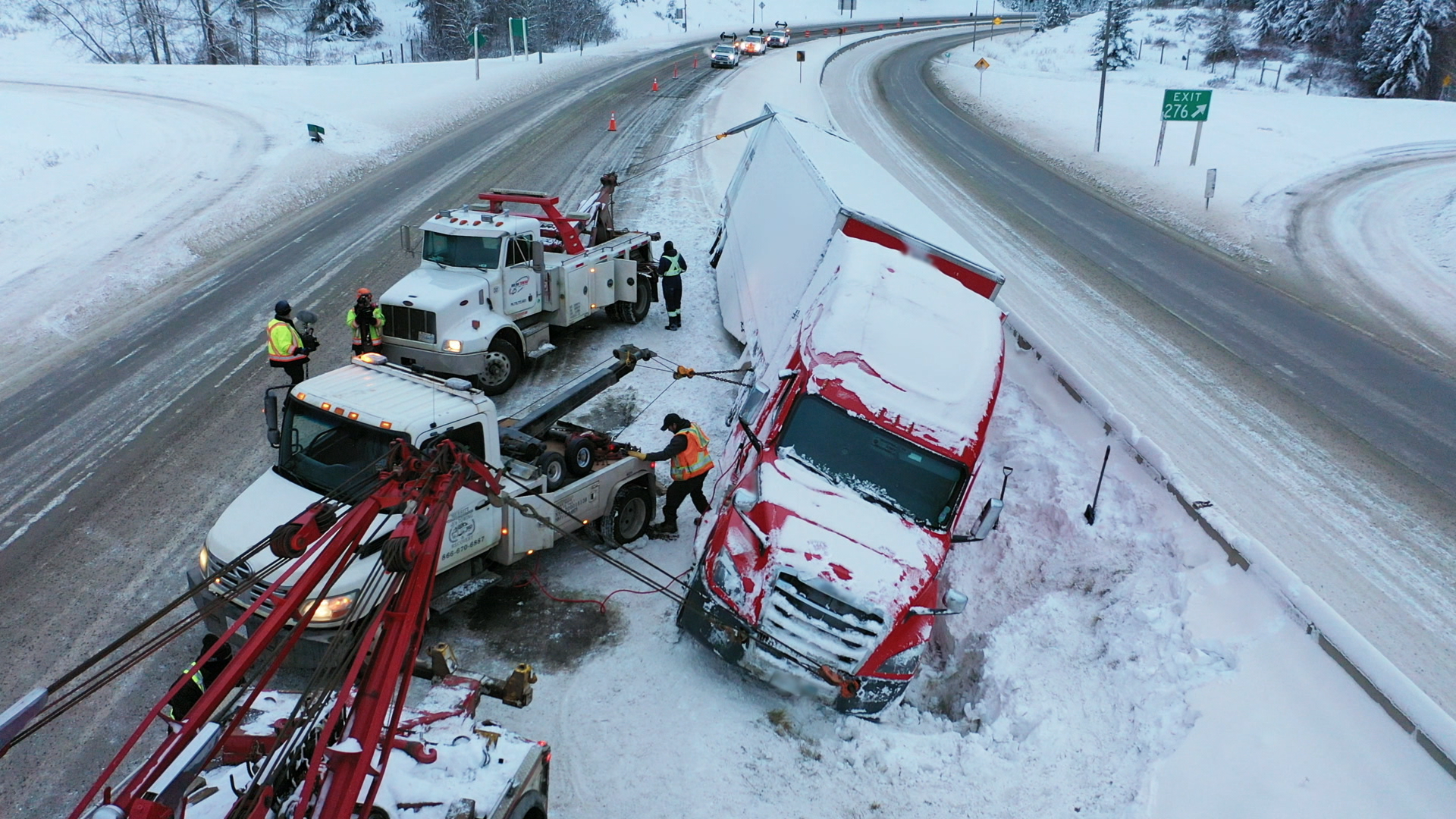
The long-running series covers heavy-vehicle rescue and recovery-towing operations on the treacherous Coquihalla Highway in the BC interior. As in East Harbour Heroes, the cast of Highway Thru Hell must grapple with Mother Nature’s worst—in this case, ice storms, mud-slides and avalanches-to rescue semis, buses, and other vehicles too large to be towed in the regular way. The show is wrapping up its 14th season of production. It’s a “very, very, very, very well-loved series” in the 180 territories in which it’s shown, says David Way, CEO of Great Pacific Media.
Clearly, it’s not just truck drivers and tow truck operators who are watching (though heavy machinery is certainly part of the appeal). “We have a pretty core audience, but we get notes from grandmothers and grandkids. It’s multigenerational now,” says Way.
The most common response Way hears? “I had no idea that people were doing this kind of work and how important it is.” And here’s that word “backbone” again: “Audiences around the world marvel at the people who do this job. They’re the backbone of what it takes to make a country work, by keeping highways safe and open for everybody to do what they need to do.”
Highway Thru Hell
According to Way, safety is number one on set. “We’re not in there, chasing the action with a camera running. No, we ask: Is this safe? Can we do this? And if we can’t, we don’t,” he says. And he insists that, while the team at Great Pacific certainly wants audiences to be entertained, “we don’t make stuff up on this show.” Why bother? The drama is already built in.
Northern Air Rescue
“They have a story to tell, and they’re proud to share it”
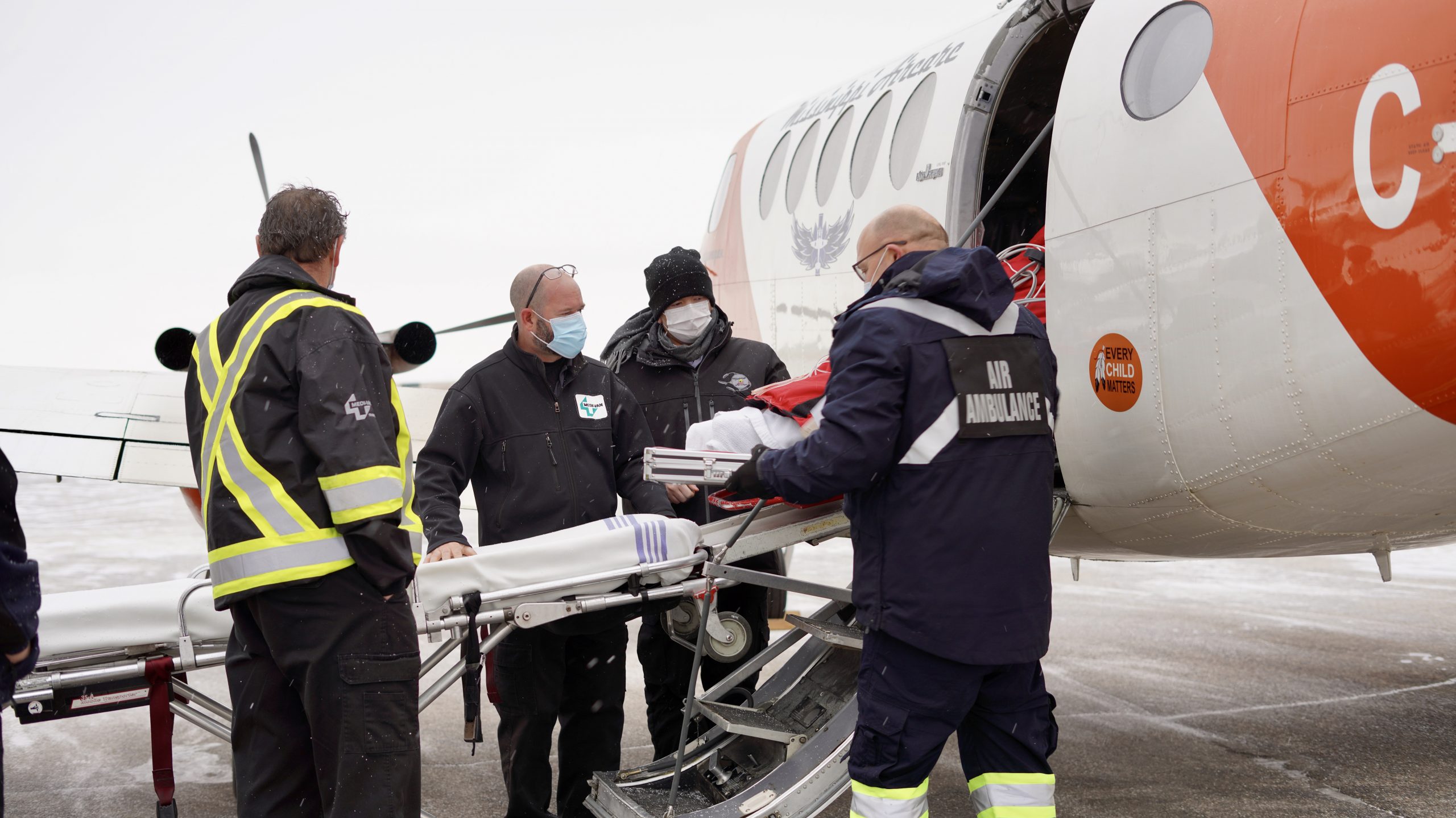
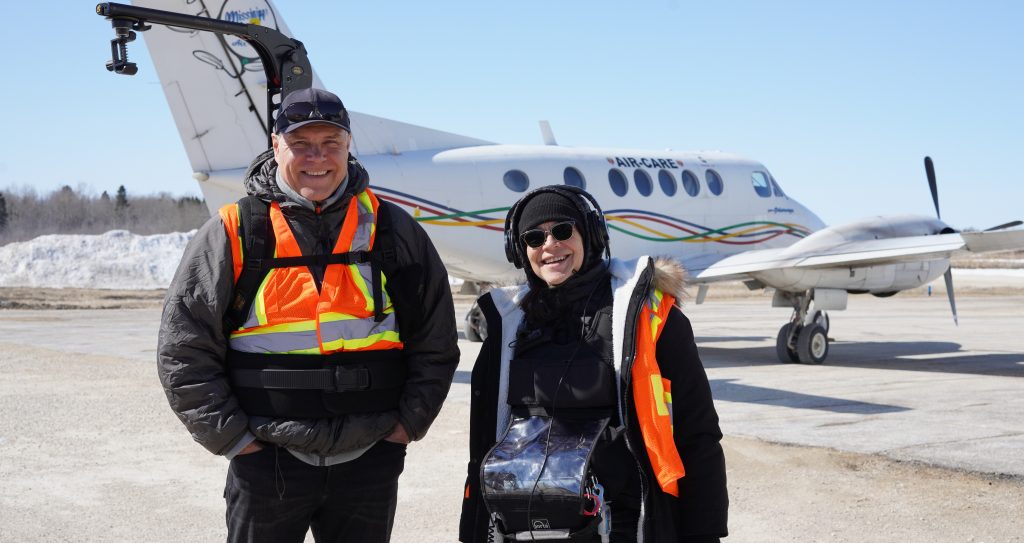
Another show that doesn’t make stuff up is Northern Air Rescue, APTN’s docuseries about Missinippi Airways, an Indigenous-owned airline operating out of Mathias Colomb First Nation in northern Manitoba. The airline performs rescue, passenger and cargo services to fly-in communities in the province.
“Northern Air Rescue highlights the remarkable stories of ordinary people who go the extra mile to serve the North,” says Adam Garnet Jones, director of TV content and special events at APTN. “We believe people connect with these stories because they see reflections of themselves and their loved ones in the commitment of the Missinippi Airways team.” The show’s origin story illustrates how popular series like these are becoming with producers. RealWorld Films’ Denis Paquette read an article in The Globe and Mail about two pilots from Manitoba who made up the first-ever female Indigenous medevac flight team. He contacted Ricky Brenton, the general manager of the airline—only to learn his was the fourth production company to call.
Ultimately, RealWorld won the day and committed to making the show in the way the airline wanted: as “a true factual series that really doesn’t play with the narrative,” says Paquette. “It’s straight up about these people and the good work they do.” APTN quickly signed on, and the series is currently in production on season two, which will release in early 2026.
Denis Paquette and Carmen Henriquez of RealWorld
The show captures the life-or-death necessity of an airline like Missinippi, for medical emergencies, the transport of goods, and evacuations during wildfire season. “There’s only one way in and one way out,” says Paquette. The pilots also perform tasks southerners wouldn’t even think of, such as flying in dog food for the dogs remaining after an evacuation. Because without the dogs, bears will come.
Beyond the ever-present threat of bears, with real-life shows comes real-life weather. This has been one of the greatest challenges for the crew. “In northern Manitoba, inclement weather is just a reality,” says Paquette. The crew deals with temperatures from -32° to plus 32°, and the notorious swarms of bugs in the summer. “It’s hard to get a steady shot when you see horseflies taking a piece of your skin out,” he says.
But the weather, as well as the time it’s taken to build relationships and create trust with the community, is well worth it. The show gives people who never have—and probably never will-set foot in a fly-in Manitoba community a deeper sense of what life and work in the North is like. And it gives the airline employees and community members a chance to share their life and work with others.
“They have a story to tell, and they’re proud to share it,” says Paquette. “It’s been an honour and a privilege to work with them. If we can capture a bit of the beauty and allow people to see a bit of the essence of life in the North, that would be fantastic.”
“It’s An Underserved Demographic, so there was definitely a need”
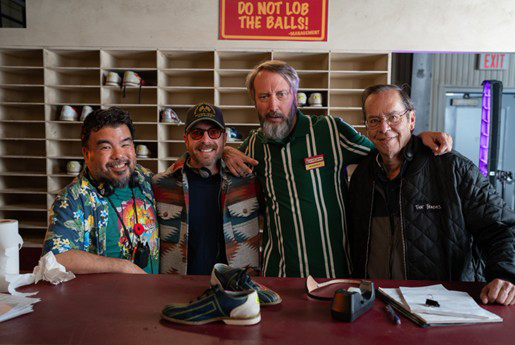
Warren P. Sonoda, Ryan J. Lindsay, Tom Green and Gary Howsam on set of The Trades
A scripted single-cam comedy about oil refinery workers sounds as distant as can be from a docuseries about pilots doing essential work in remote Manitoba. But The Trades (airing on Crave) is also rooted in reality. And while, according to its creator, it’s “ridiculous” and “crass” — it’s co-produced with the Trailer Park Boys—it’s got heart to spare.
Creator Ryan Lindsay (Kontent House Productions) based the series on his own experiences growing up in Sarnia, Ontario, a city “propped up by oil refineries,” he says. His younger brother, Tyson, is a pipefitter. His youngest brother, Kellan, is a carpenter. When Lindsay moved to Toronto to work in the film industry, he’d come home with what he thought were great stories, “working with the Guillermo del Toros, the David Cronenbergs. But my stories always got trumped by my brothers’ misadventures and workplace antics.”
He brought on his brothers as consultants for the show, and also got to work interviewing hundreds of tradespeople. He wanted to learn the local jargon, the juiciest workplace stories, the funniest nicknames.
“A lot of the show is based off of real things that have actually been said and done,” says Lindsay.
It’s those tradespeople that he makes the show for, though of course it has the ability to resonate with anyone who’s had a quirky colleague.
“Blue-collar individuals account for a third of our population globally, and they consume a large quantity of content,” says Lindsay. “It’s an underserved demographic, so there was definitely a need. But regardless of demographic, it’s those relationships within a work family that provide the humour and drama and heart.”
“The unsung heroes, the individuals that keep our lights on and our water running”
While the show is a comedy, it also addresses important workplace issues, such as women’s representation in the trades. One female character, Audrey, pursues a career as a carpenter, and the show follows her trajectory from orientation to apprenticeship and beyond.
Again, while undoubtedly a comedy first, Lindsay asserts that the characters it portrays “arethe unsung heroes, the individuals that keep our lights on and our water running.” He wants to make content that showcases pipefitters and welders and boilermakers—but what he really wants to do is make them laugh. “There are unlimited options for content, but why shouldn’t they watch a show that gives them a bit of ownership?” he says.
The Office Movers (Counterfeit Pictures)
“What are the stories we can tell within the parameters we have?”
Dan Bennett
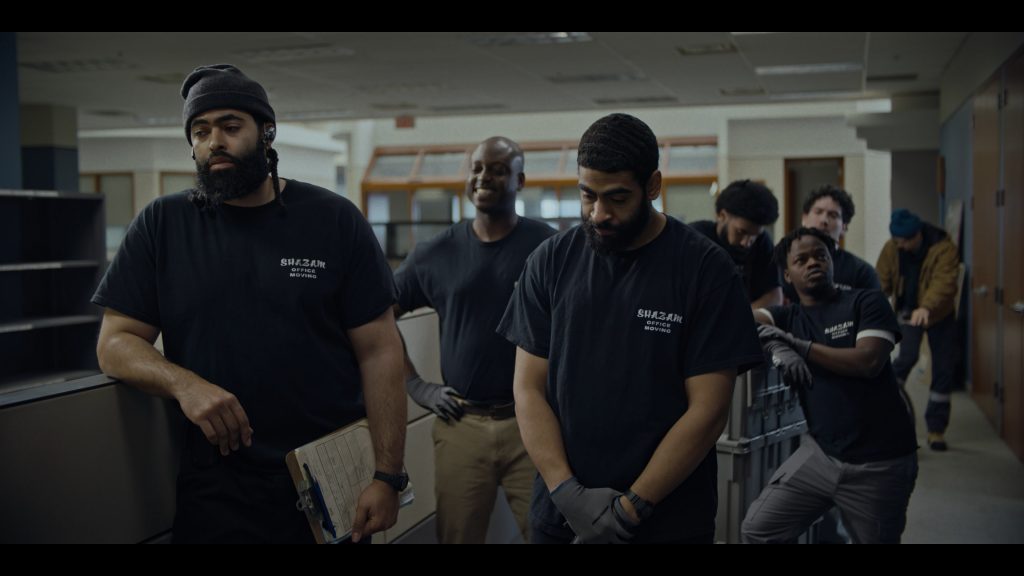
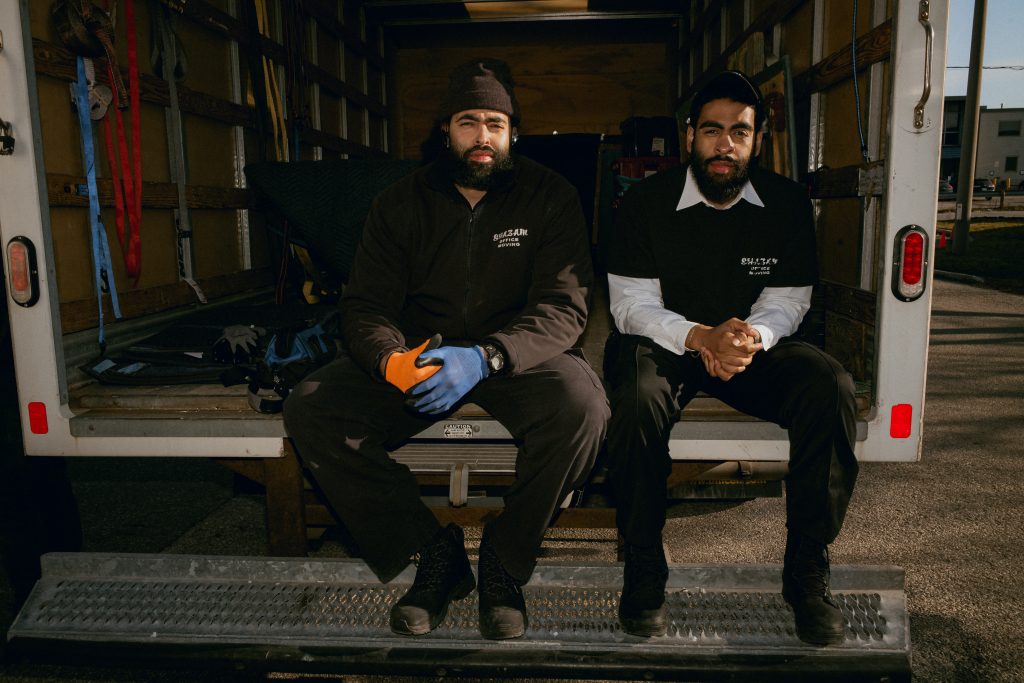
The Office Movers, also on Crave, is another blue-collar comedy, this time about a mishap-plagued office moving company run by two brothers (played by creators Jae and Trey Richards). It’s based on their real-life experiences working for their father, and their unglamorous, just-get-through-the-day anecdotes provide plenty of laughs, as well as all-too-real situations that many can relate to.
“Everett [played by Jae Richards] is trying to run a company with everything stacked against him,” says Dan Bennett, of Counterfeit Pictures. “He’s trying to do right by his people and by his clients, but it’s like trying to catch sand. It all slips through his fingers. I think people can relate to that: you just try to do your best and you live to fight another day.”
According to Bennett, a show like The Office Movers, which films in warehouses and on loading docks, plays to the Canadian industry’s creative strengths and production limitations. “Our budgets are getting smaller in Canada,” he says. “I can’t get a budget to make Succession. So what are the stories we can tell within the parameters we have?”
“Grounded, real, everyday shows: these are things that Canadian producers excel at,” he continues. “We need to continue to look for opportunities in those worlds, because they’re our strong suit.”
They’re also audience favourites. Whether they’re lonely farmers, brave captains or hapless office movers, viewers want to see shows featuring people who aren’t afraid to get their hands dirty. Authenticity is the name of the game.
“I feel like we’ve passed the stage of the big, shiny, aspirational shows,” says Bennett. “People want to feel something a little more real.”
Judging by the wide variety of authentic workplace shows, the people are getting what they want.
Read more indiescreen
Canucks in capes
Years in the making, Atomic Cartoons’ animated show about overlooked über-Canadian superheroes could hardly have dropped at a more auspicious time
Agnes Augustin, CEO of the Shaw Rocket Fund—Canada’s largest private funder for kids’ content—diagnoses the ailing kids’ sector, and suggests a path back to health.
“Enhancing the well-being of Canadian and Indigenous children with new and relevant stories that help them navigate the world we live in today far exceeds the “burden” of investment in new children’s content. It is an investment in our kids and their future.“
Agnes Augustin, CEO of the Shaw Rocket Fund
The Canadian and Indigenous children’s production industry is in crisis. While our sector has seen ebbs and flows over the years, nothing compares to what the global kids’ media industry is experiencing today. In a world where cost cutting has become the norm due to post-pandemic recovery and inflation, government organizations and legacy companies are evacuating the kids space to improve bottom lines. It’s apparent in many headlines: “Nelvana development team axed,” “HBO Max, Netflix scrap kids shows,” “UK government shutters Young Audiences Content Fund,” “Disney has a kid crisis.”
The rationale: kids’ shows are costly, return on investment is limited, and kids are online anyway.
Since the heydays of the ’90s, when Nelvana and Cinar ruled the kids’ space, we have seen a steady decline in the production of Canadian and Indigenous children’s content, as a series of regulatory decisions inadvertently reduced commissioning, funding and overall support of new and relevant Canadian and Indigenous programs for kids of this generation. How did this happen?
Regulatory support is directed to programming that is deemed to be of public interest, and that would not exist without support because of “market failure.” In 1999, the Canadian Radio-television and Telecommunications Commission (CRTC) determined that kids in Canada had access to Canadian and foreign programming on a regular basis, and therefore deemed that children’s programming was no longer considered a priority. As a result, the regulator removed CanCon time credits for children’s content during “primetime for children” (daytime), thus eliminating the incentive for broadcasters to air kids’ programs.
The negative impact of these decisions slowly chipped away at the Canadian children’s programming sector for years. Then, another detrimental regulatory shift occurred in 2015, when the CRTC removed genre protection, eliminating the requirement for Canadian kids’ broadcasters to air Canadian children’s programming. Ironically, one could argue the kids’ production industry was a victim of its own success.
Interestingly, many Canadian dramas have seen global success—Heartland, Murdoch Mysteries, and the Golden Globe- and Emmy-winning Schitt’s Creek—and yet Canadian drama is still considered a “market failure” and receives the lion’s share of the funding in our country. The kids’ sector, on the other hand, has seen government funding continue to shrink.
In response to reduced funding, Canadian producers of children’s content grew to rely on international partners, particularly the US and Europe, to complete their financing. While this worked for a while, the drastic contraction in the US kids’ market has shattered the Canadian and Indigenous children’s production sector, and considering that 48 percent of all kids’ channels in Europe are US-owned, the effect on our industry is, and will continue to be, massive.
Failing our kids
It begs the question: why does the international market determine if we can continue to produce great Canadian shows for Canadian and Indigenous kids? Shouldn’t we, as a country, ensure that our children have access to new and relevant Canadian programs and media experiences on platforms of their choice? Kids deserve to see a Canadian and Indigenous point of view among the global content they have access to.
Canada’s private kids’ broadcasters, WildBrain and Corus, are experiencing significant financial challenges for many reasons, including the impact of last year’s WGA and SAG-AFTRA strikes. The CRTC recently granted Corus precedent-setting relief by reducing its PNI spend obligation from 8.5 per cent to 5 per cent (estimated at $31.8 million in 2023), shifting this spend to other content such as news and reality, and, depending on interpretation, with no further spend requirement on programs of national interest (PNI) for the remainder of its three-year licence term. The headline read: “Eased CanCon rules allow Corus to lean into unscripted reality, lifestyle fare.” No mention of kids.
The responsibility of creating new children’s programs has fallen on our public broadcasters, who do not have the means to make up for the lack of commissioning of children’s content from private broadcasters. And, frankly, they shouldn’t even if they could, as the difference in the private and public focus ensures a diversity of stories, voices and business.
Canadian and Indigenous children’s programming fosters positive values and relationships, builds diverse cultural awareness and pride, and sparks imagination and critical thinking through a mix of entertainment and education—all within a Canadian voice. Exposure to new content can lead children away from negative, sometimes toxic content that is widely available to them today, and can lead to healthier media consumption habits in youth and adulthood. Enhancing the well-being of Canadian and Indigenous children with new and relevant stories that help them navigate the world we live in today far exceeds the “burden” of investment in new children’s content. It is an investment in our kids and their future. And yet, legacy broadcasters, governments and regulators no longer seem to value the importance of children’s programming, and any sense of responsibility to Canadian and Indigenous kids seems to have been lost.
We know that kids discover lots of content online that they enjoy, including short-form and user-generated content, as well as legacy high-quality shows and repurposed content that were paid for by legacy broadcasters. But, if we don’t figure out how to finance and create new and relevant Canadian and Indigenous programs for kids at a high standard on these platforms, we will have failed them
If we don’t figure out how to finance and create new and relevant Canadian and Indigenous programs for kids at a high standard on these platforms, we will have failed them.
Time to Act
Canadian and Indigenous children and youth under 18 represent close to 20 per cent of Canada’s population. Generation Alpha, born from 2010 to 2024, will be the largest generation in the history of the world by 2025, estimated at 2 billion. The first in this generation were born the year the iPad was launched and Instagram was created, grew up with Siri and Alexa, and are experiencing rapid AI advancements with ChatGPT and other new platforms. We must find a way to offer Canadian and Indigenous kids and parents trusted content that reflects the way kids consume content both today into the future. This will require considerable private and public investment.
The Online Streaming Act (Bill C-11), which could see an estimated $200 million contribution toward Canadian-made audiovisual and audio programs, offered some hope. And yet, the CRTC’s recent related Broadcasting Regulatory decision failed again to prioritize Canadian and Indigenous children and will not benefit children’s content, as it did not direct or even incentivize any of the recipients to consider kids in their remit. The Rocket Fund, the only dedicated Certified Independent Production Fund (CIPF) for children’s and youth content, was not guaranteed an allocation of the regulated contributions along with the other legacy CIPFs.
The main issue is that children’s programming is defined as a genre of programming by our governments and regulators, and—inconceivably—not thought of as essential for our children. Regulatory and governmental decisions are made without consideration or safeguards that would ensure Canadian and Indigenous children have access to, and the right to, relevant Canadian-made stories.We must find our way back to prioritizing Canadian and Indigenous children, as a special audience group and not a genre, within the Canadian broadcasting and online streaming systems. We need to raise awareness of the importance of high-quality children’s programs for kids today, to ensure that meaningful, relevant content is created for our media-savvy children. But how can we do this when the kids’ industry is contracting at what feels like a record pace?
We, as a country, must acknowledge the crisis and urgently unlock the current funding we have, to allow producers of children’s content easier access while offering flexibility with the platform triggers. Having meaningful access to Canadian funding would also help kids’ producers secure international financing through co-productions to help fund their programs while we continue to work on solutions. We need a movement.
The children’s media industry is one of the most influential and powerful businesses in the world when it comes to kids. The fundamental value of Canadian and Indigenous programming for all children and youth in Canada must be underscored. Our programming reflects the diverse experiences of all children in our country—Black, racialized and Indigenous children, newcomers, children with disabilities. This is why, more than ever, stable funding is crucial to ensure the ongoing creation of quality and relevant Canadian and Indigenous programming for our children. We must act now.
Read more indiescreen
The Art of Producing
Producers and industry executives share their wisdom on creative producing: what it means and how to nurture a vision, whether it’s your creative team’s or your own.
Agnes Augustin, CEO of the Shaw Rocket Fund—Canada’s largest private funder for kids’ content—diagnoses the ailing kids’ sector, and suggests a path back to health
The Indiescreen Awards go east for the first time ever.
The Indiescreen Awards, now in their 19th year, honour Canada’s most outstanding and most promising feature film producers. This year, the awards ceremony will be held at the Atlantic International Film Festival in Halifax—a first in Indiescreen Awards history. Check out this year’s list of remarkable nominees.
Established Producer Award
Nominees for the Established Producer Award are recognized for their collective body of work, as well as their contribution to the reputation of Canadian cinema on the world stage.
Aeschylus Poulos
Company: Hawkeye Pictures Qualifying Film: Paying for It
Aeschylus Poulos is co-founder of Hawkeye Pictures, an award-winning producer of feature films, documentaries, and series. Poulos’s film, Paying for It, premiered at TIFF.
Alison Duke
Company: OYA Media Group Qualifying Film: Bam Bam: The Sister Nancy Story
Alison Duke is an accomplished writer, producer, and director, with a two-decade track record in storytelling. In addition to creating award-winning content, Alison mentors up-and-coming creatives through OYA Black Arts Coalition. Alison’s film Bam Bam:The Sister Nancy Story premiered at Tribeca.
Company: Eagle Vision Qualifying Film: Deaner ’89
Partners Lisa Meeches, Kyle Irving, and Rebecca Gibson lead the award-winning production company Eagle Vision, which has produced more than 250 hours of content. Their latest film, Deaner ’89, opened in theatres in September 2024.
Marie-Claude Poulin
Company: Sphère Media Qualifying Film: 1995
Marie-Claude Poulin joined Sphère Media in 2021 and has been an award-winning producer in the film industry for over 25 years. Poulin’s film, 1995, was released theatrically in summer 2024.
Martin Katz
Company: Prospero Pictures Qualifying Film: The Shrouds
Martin Katz is the founder and president of Prospero Pictures, whose credits have earned esteemed awards and nominations. Katz is a recipient of the Queen’s Jubilee Medal and was invested as a member of the Order of Canada. His film, The Shrouds, premiered at Cannes.
Kevin Tierney Emerging Producer Award
Nominees for the Kevin Tierney Emerging Producer Award are recognized for inspirational work, demonstrating promise of a bright career ahead as a Canadian independent feature film producer.
Annick Blanc, Maria Gracia Turgeon
Company: Midi La Nuit Qualifying Film: Hunting Daze
Annick Blanc and Maria Gracia Turgeon together lead their production company, Midi La Nuit. Their award-winning films have been shown in renowned international festivals. Their film, Hunting Daze, premiered at SXSW.
Enrique Miguel Baniqued, Karen Chapman
Company: Smallaxx Motion Pictures Qualifying Film: Village Keeper
Enrique Miguel Baniqued arrived in Toronto from the Philippines in 2019, and met Karen Chapman when he was a production assistant on Chapman’s award-winning film Quiet Minds Silent Streets. Their latest collaboration, Village Keeper, premiered at TIFF.
Julie Baldassi
Company: Younger Daughter Films Qualifying Film: Darkest Miriam
Julie Baldassi is a Toronto-based producer and, with her company Younger Daughter Films, has been selected or awarded at renowned international film festivals. Baldassi’s film, Darkest Miriam, premiered at Tribeca.
Mike Johnston
Company: Studio 104 Entertainment Qualifying Film: Curl Power
Mike Johnston is an award-winning producer and the co-founder of the Vancouver-based production company Studio 104 Entertainment. His film, Curl Power, premiered at Hot Docs.
Ngardy Conteh George
Company: OYA Media Group Qualifying Film: A Mother Apart
Ngardy Conteh George is co-founder of OYA Media Group, and an award-winning director, producer, and editor. She is also co-founder and board chair of OYA Black Arts Coalition, an organization focused on supporting Black filmmakers and entrepreneurs in the film, entertainment, and digital media industry. Her film, A Mother Apart, premiered at Hot Docs.
Read more indiescreen
A Matter of Fact
In conversation with Sarah Spring, executive director of the Documentary Organization of Canada (DOC).
The creators of Law & Order Toronto: Criminal Intent on the show’s origin, the magic of letting Toronto play itself, and the spectacular challenge of making the old feel new.
Did you know that Canada has more co-production treaties—nearly 60—than any country in the world?
Canadian producers are world leaders when it comes to collaborating with global partners. But, as many will tell you, it can be quite a challenge to ensure all the pieces fit together, to produce a project and have it end up on screen.
Kate Harrison Karman, president of Toronto-based Cream Productions, has plenty of experience with co-productions, including Stuff the British Stole, a Canada-Australia co-pro (which won Best History Documentary Program or Series at the Canadian Screen Awards); An Optimist’s Guide to the Planet, with the UK; and Wild Things with Dominic Monaghan, another Canada-UK co-pro. She is a firm believer in the model, which allows for fruitful collaboration in a challenging industry environment. “It can be a real strength for producers to support each other,” she says.
According to Harrison Karman, a co-production is a lot like a marriage: before you take the leap, you need to know what you’re getting into; then, you need to stay connected. She says that producers need to ask themselves four questions before they commit to a co-production—and stay true to the shared vision once they begin.
What to ask
Is a co-production right for your project? Ask yourself the following questions before you get started:
1. Why are we considering the co-production option?
Is it financing, talent, the subject matter? Any of these are legitimate reasons, but each affects the shape your co-production will take.
2. Who is our co-production partner (or partners)?
Have they successfully completed a co-production before? Do we have the same vision for the project? Pay attention to red flags before you get in too deep.
3. Does the creative make sense to co-produce?
If so, how will we split the responsibilities?
4. Are our financing partners (networks, distributors, etc.) comfortable with the co-production route?
This is critical. If they’re not on board, you have some convincing to do—or you need to look at alternative options.
How it works
No two co-productions are alike—but the successful ones have the following elements in common:
1. A singular creative vision (and an agreed-upon budget and schedule).
You and your partner(s) need to be on the same page and stay there, from day one until the project is done.
2. Full transparency across all facets of the production.
How else will you know if you’re on the same page? You should be honest and accountable about all aspects of the financing and creative, and expect the same from your partner(s). Plan on weekly or biweekly check-ins, and openly discuss any challenges you’re facing.
3. A clear and detailed breakdown of responsibilities.
If you’re a producer, you already know that this is the only way to avoid pitfalls down the road.
4. A balanced approval process for hiring key creatives, scripts, cuts, etc.
If you work this out beforehand, it will save you headaches—and potential conflict—later.
5. Teamwork.
There needs to be a sense of unity and shared purpose—both sides helping their staff develop into one team that’s making one show (or film).
6. Clear communication between producers and all networks.
This is absolutely crucial, and tied to all the other points. When you have open communication, everything else will fall into place.
HOW IT COMES TOGETHER
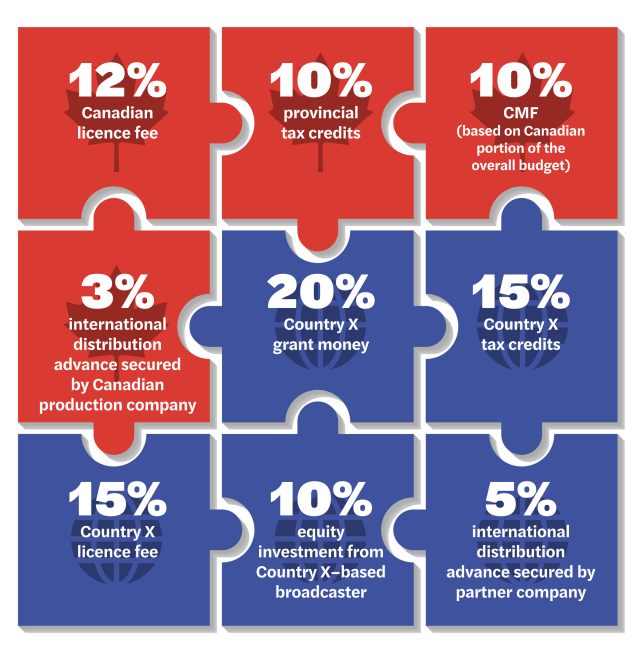
Harrison Karman is the first to admit that there’s no one way to structure a co-production, but offers the following example of how it can come together, based on previous experience:
12% Canadian licence fee
10% provincial tax credits
10% CMF (based on Canadian portion of the overall budget)
3% international distribution advance secured by Canadian production company
20% Country X grant money
15% Country X tax credits
15% Country X licence fee
10% equity investment from Country X–based broadcaster
5% international distribution advance secured by partner company
“You have to be on the same team; you have to be making the same show. It’s like any relationship: you need to know who’s responsible for what, because at the end of the day, if somebody goes sideways, you go sideways with them. On the flip side, success can be even sweeter when it’s shared.”
Kate Harrison Karman
Read more indiescreen
A Matter of Fact
In conversation with Sarah Spring, executive director of the Documentary Organization of Canada (DOC).
The creators of Law & Order Toronto: Criminal Intent on the show’s origin, the magic of letting Toronto play itself, and the spectacular challenge of making the old feel new.
The creators of Law & Order Toronto: Criminal Intent on the show’s origin, the magic of letting Toronto play itself, and the spectacular challenge of making the old feel new.
“People feel very strongly about Law & Order,” says Amy Cameron, co-founder and executive producer at Toronto’s Cameron Pictures.
For her, and the new project she was behind, she knew that could be a blessing or a curse. In February, her company’s new series, Law & Order Toronto: Criminal Intent (in partnership with Lark Productions), premiered on Citytv. More than a million viewers tuned in to the first episode, flinging the series into the number one primetime drama spot in Canada. It was that increasingly rare species, a television event, and people were curious to see how two very familiar entities—Law & Order and the city of Toronto—would mesh on screen.
The viewers, it seemed, liked what they saw and have largely stuck around for the rest of the series. As they watched, a new question arose in the minds of many: just how did Law & Order, that venerable American institution, land on these northern streets?
“People feel very strongly about Law & Order.”
Amy Cameron
Origin of an original
“It all started with Rogers,” explains Erin Haskett, president of Lark Productions. As holder of the Canadian rights to the Law & Order franchise, Rogers Sports & Media had a longstanding relationship with Dick Wolf, the franchise’s creator, and NBCUniversal, its home network. Rogers was the first mover on the project, and reached out to Lark to explore the possibility of creating a Canadian Law & Order.
An international original of Law & Order had never been done before—sure, there was a UK version, a French version and two Russian versions, but these were all adaptations that recycled scripts from their parent series. Law & Order Toronto is an original series, with the characters and story lines all built from the ground up.
In many ways, Canada was a perfect place for an original Law & Order to take root. “Canadian audiences have already seen all those American scripts in English,” says Haskett. “We’re very close to the US culturally; we’re very close to them geographically. Audiences want something to feel like it’s their own.”
What also helped are the unique elements of the Canadian system, says Haskett. Broadcaster partnerships, CAVCO tax credits, Canada Media Fund financing: all of these depend on producers developing distinctly Canadian productions, not copycats of American forerunners. So, maintains Haskett, telling Canadian stories was certainly a creative decision they were happy to make, but within Canada’s broadcasting system and incentive structures, “That is also what needed to happen.”
Getting a Canadian Law & Order off the ground was a two-part equation: one part financial, the other creative. According to Haskett, the financing half of the equation came first. Once they confirmed that NBCUniversal was willing to participate and that Rogers could finance the production at a level necessary “to sit side by side the other Law & Orders,” they began to determine the right writers to nail the brand.
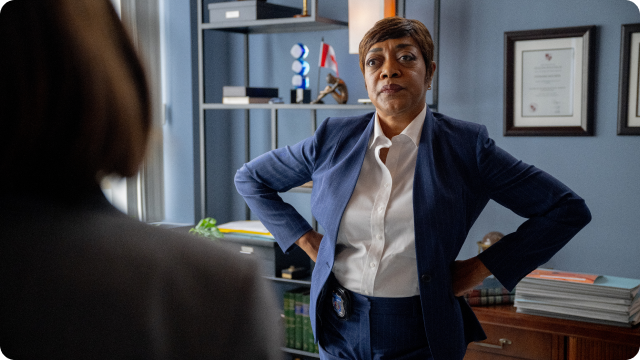
The creative team began with showrunner Tassie Cameron of Cameron Pictures, whose past credits include procedurals like Rookie Blue, Private Eyes and Pretty Hard Cases. Her ability to develop a compelling script and intriguing characters—Detective Sergeant Henry Graff, the enigmatic walking encyclopedia; Detective Sergeant Frankie Bateman, the incisive single mom with a climate-controlled demeanour; the deliciously no-nonsense Inspector Vivienne Holness—drew other creatives to the project like a magnet. (The built-in “lure of the franchise” didn’t hurt either, says Amy Cameron.)
Karen Robinson as Inspector Vivienne Holness.
A capital location
“I think Toronto’s having a renaissance, and it’s a beautiful and cool place to shoot.”
Tassie Cameron
If you’re a west coaster with a Vancouver bias, or a Canadian who doesn’t see Hogtown as the centre of the universe, you may be asking, “But why Toronto?”
For those involved, however, it was pretty simple. Toronto is Canada’s largest city (and largest market), well known outside of Canada’s borders, and astonishingly diverse.
“It’s quite an incredible tapestry to work from to set stories in,” says Tassie, noting the side-by-side placement of distinct and vibrant neighbourhoods, from Chinatown to Little Italy. “I think Toronto’s having a renaissance, and it’s a beautiful and cool place to shoot.” In any case, it was Rogers’ choice to make, and “it was always going to be Toronto,” says Haskett. “The Wolf format team also felt that Toronto is a big city where we want to see what crime looks like.”
And from the opening moments of the first episode, which reveals Toronto’s skyline from a speeding yacht on Lake Ontario, viewers can delight in watching Toronto play itself. A fabric store in Little India. The skating rink at Nathan Phillips Square. The Dundas streetcar. Construction cranes everywhere.
“One thing people know about Toronto is that it often stands in for New York and so many other places, so it’s fun to showcase it and really see it as Toronto,” says Amy.
Aden Young and Kathleen Munroe as Detective Sergeant.
A fine balance
“The expectation is that we match the rest of the franchise from a production value standpoint.”
Erin Haskett
It’s all well and good to pepper a script with Toronto references, but how to make the show look and feel Canadian while looking and feeling like Law & Order?
Haskett and the rest of the team understood that the bar was high. “The expectation is that we match the rest of the franchise from a production value standpoint, but that we also have a very distinct reason for taking up a slot in CityTv’s Dick Wolf Thursday night lineup,” she says. “That was the real test for Lark and for Cameron [Pictures] and for Rogers.”
Tassie Cameron and the rest of the writers’ room had their work cut out for them. First, the show belongs to the Criminal Intent format. While classic Law & Order divides episodes into an investigation and a criminal trial, Criminal Intent series focus almost exclusively on solving the crime, at the expense of courtroom drama. Tassie describes the format as “Sherlock Holmesian,” which makes it “quite a hard show to write, much harder than it appears. You need a certain kind of writer who has a very logical, almost mathematical or crossword-puzzle brain.”
Dick Wolf’s team supplied the Canadian team with the Criminal Intent “bible,” which detailed the format’s many rules—for example, in every act, an episode must shift to the criminal’s point of view. “You have to abide by the rules of the franchise, but then you’re also trying to update them and make your show feel Canadian,” says Tassie. “You’d think with these format rules in place that it would be quite easy to slot things in, and yet somehow it’s not.”
The writers continually had to stay one step ahead of the audience, who would be familiar not only with the format, but also with the headlines that the stories were inspired by—like the mysterious death of the shady CEO of a Canadian crypocurrency exchange, or the Toronto mayor caught smoking crack on video. The writers couldn’t retrace the actual stories exactly, or they’d quickly bore viewers; instead, they’d “spin [the headline] in a different direction that, ideally, people haven’t anticipated, often with the help of another headline or two,” says Tassie.
Adhering to the rules of the franchise proved to be more difficult than anticipated in the editing room as well. Amy Cameron describes sending off the first producer’s cut of an episode to the distributors, Rogers and NBCUniversal, and receiving notes that informed her that they weren’t properly using Law & Order’s famous “dun-dun” sound.
“I thought, I’m sorry, but how hard is it to use the ‘dun-dun’ properly?” she laughs. “But without realizing it, we were using it as punctuation on a scene. It felt good to throw a ‘dun-dun’ in there after a scene, where in fact the ‘dun-dun’ is meant to be an intro. You have a black location card, you do your ‘dun-dun.’ It’s a tiny little thing, but had someone not caught that for us, I think our audiences would have said, ‘Ohhh, there’s something wrong here.’” She adds, “Luckily, we have a lot of people who have worked on the show for a long time helping us catch mistakes!”
A grand reception
So, did they stick the landing? Did the team create a recognizable Law & Order world within the Toronto universe?
It would seem so. Thanks to its high viewership numbers, the series has, unsurprisingly, been renewed for a second and third season. “We are holding our own and even exceeding the [ratings of] US versions of the franchise, which is really exciting,” says Haskett.
The team credit much of their early success to the strong promotional push before the first episode aired, when “you couldn’t turn your head in many parts of the country without seeing a billboard or a digital ad on your phone or within the programs you were watching,” says Haskett. “Rogers put the entire machine behind it.”
“I’ve never been on a series before that had such strong marketing,” adds Tassie. “They put so much behind it, and it really showed.”
And while viewers’ strong feelings about Law & Order could be either a pro or a con, in this case, the “lure of the franchise” proved to be an advantage once again.
“When I got the first overnight ratings, I burst into tears,” says Tassie. “I was so overwhelmed with how grateful I felt that Canadians had come and shown up for this live the night it aired.”
“People will always show up to sample a new Law & Order,” says Amy. “I think people will come because of the strength of the franchise, and then, I hope, stay and be delighted. That’s the power of the franchise: if you can hit the right elements and engage people’s brains in a way that’s familiar and yet completely new—new stories, new characters—there is something incredibly compelling about that.”
“Thanks to its high viewership numbers, the series has, unsurprisingly, been renewed for a second and third season.”
Erin Haskett
On the set of the show.
Read more indiescreen
The Media Cartographer’s Guide to the Galaxy
Evan Shapiro on the shifting media universe, and the role of regulations in combating the gravitational pull of the giants.
We spoke to three current Conservative premiers about the steps they’ve taken to stimulate investment in their province’s production sector, and why the industry remains a key priority for them into the future.
As Indigenous comedy gathers speed, Canadian audiences are starting to catch up.
Indigenous comedy is having a moment. That’s according to Kerry Swanson, CEO of the Indigenous Screen Office, who notes broadcasters’ heightened interest in the genre of late. “We’re seeing that across the board,” she says.
One of the biggest recent successes in the genre is Acting Good, an absurd-in-the-best-way sitcom that will soon air its third season. The first two seasons introduced us to Paul—a mama’s boy (played by series creator Paul Rabliauskas) who finds himself back on his northern Manitoba reserve after being chewed up and spit out by the big city of Winnipeg—and a delightful ensemble of kookier-than-thou characters.
Rabliauskas, a stand-up comedian, had been pitching variations of Acting Good for 10 years before it got picked up by Bell Media. It’s based on his own experiences and his own community: Poplar River First Nation in northern Manitoba, where he grew up, is a direct inspiration for Acting Good’s fictional fly-in community of Grouse Lake First Nation.
Since his show got the green light, Rabliauskas says it’s been both a “whirlwind” and “a dream come true.” He admits to early fears that nobody would watch it, “because it’s about my life and it’s Indigenous.” On the contrary: the show is now CTV Comedy Channel’s top-rated series.
“I think Canadians are really taking to our stories,” says Rabliauskas. But far from satisfied with the success of his show alone, he says, “I think we need five or six more [Indigenous] comedies on all the networks everywhere.”
Paul Rabliauskas as Paul, Avery Sutherland as Chickadee, and Gabriel Daniels as Dean on Acting Good
He may soon get his wish. North of North (Red Marrow Media, Northwood Entertainment), about a young, single Inuk mother trying to make a new life for herself and her daughter in her tiny Arctic town, is scheduled to premiere on CBC and APTN, followed by Netflix, in 2025. BC-based Haisla hip-hop duo Snotty Nose Rez Kids will be releasing their own scripted comedy series in the coming year. And Don’t Even (Pier 21 Films, Frantic Films Manitoba, Sekowan Media), a coming-of-age series set in the late ’90s that follows two best friends in the summer after their last year of high school, will air on Crave and APTNt. (Think My So-Called Life, but make it funny, First Nations and “friggin’ Winnipeg.”)
“Our audiences have loved Acting Good,” says Justin Stockman, Bell Media’s VP of Content Development & Programming. “Content that reflects all Canadian experiences, across both comedy and drama, is a cornerstone of our English commissioning strategy.”
Stockman adds that he’s excited to see this momentum continue with Don’t Even.
Indigenous comedy is nothing new, and with fresh new content on the horizon, audiences in Canada will hopefully get to see more of it on major broadcasters and streaming services. But Acting Good producer Tina Keeper (who also plays Paul’s mother, Agnes) points out that her show is the first of its kind to be carried by a mainstream broadcaster.
“Bravo to Bell Media; I am so grateful to them for taking the step,” Keeper says. “But still, it’s kind of embarrassing to have gone this long without public broadcasters working with Indigenous creators.”
It’s also a shame that audiences have been deprived for this long. According to Swanson and the teams behind the new shows, there’s something about Indigenous comedy that just makes sense.
Roseanne Supernault as Jo and Jason Mason as Lips on Acting Good
Says Swanson, “Humour and comedy are so foundational to Indigenous cultures and communities, and it’s really exciting that Canadians can now have the opportunity to be exposed to that.”
“We find humour in the darkest places,” says Rabliauskas. “Indigenous people have had so much tragedy and struggle in our lives that I think humour helped us get through all that stuff.” Meg MacKay, a co-producer on Don’t Even, describes an upbringing where comedy was used to communicate, tackle difficult subjects and relate to one another. “You can always tell that someone in my family likes you if they tease you,” she says. “You know you’re welcomed in.”
Amber-Sekowan Daniels, creator of Don’t Even (and a co-creator on Acting Good) agrees: “Something we literally say all the time is, ‘Laughter is medicine.’ I know when people think about Indigenous cultures, there’s this idea of stoicism. And that definitely exists. But part of the teachings I grew up with were around humility, and humour is a part of that—we tease each other to keep each other humble.” Like Rabliauskas, Daniels wanted to use her series to showcase where she grew up and spent her formative years—in her case, Winnipeg.
Daniels notes that she hadn’t seen a lot of urban coming-of-age films or series, let alone urban Indigenous ones. “Winnipeg is a very, very special place to grow up, and it has a huge Indigenous population. So that setting was really important for me,” she says.
Virtually all of these new series are rooted in real places and real experiences, making it easy for people from those places to relate. And make no mistake: these shows are made for Indigenous audiences first and foremost.
Says Swanson about some of the if-you-know-you-know humour on Acting Good: “That is authentic Indigenous storytelling, where those stories are being told by Indigenous people primarily to Indigenous audiences, and everyone is invited into the circle. But I love that we’re at a point where Indigenous storytellers don’t have to try to be anything other than who they are.”
But that doesn’t mean the jokes are lost on everybody else. After all, everyone is invited into the circle, as Swanson says. As we’ve seen so often with shows that have a tightly focused subject matter (and what looks like limited appeal), the universal can be found in the particular. Shows like Acting Good and Don’t Even won’t reach audiences and win hearts by pandering to non-Indigenous audiences or stripping out all the insider jokes—viewers want to see the real thing.
“Our TV show is about a remote fly-in community. Our creators have that background, and most of our cast members have that background, and it’s really informed our work. So we were surprised that we were so successful in the ratings,” says Acting Good’s Tina Keeper. “What I’ve concluded is that everything is universal. This is a wacky, kooky little show, but it’s focused on community—tiny family units that everybody knows. I think that is something that people relate to.”
Says Rabliauskas, “When I get recognized on the street, at this point it’s almost 50/50 in terms of Indigenous and non-Indigenous people who come up to me and say they love the show.”
Aqqalu Meekis as Stephen Harper and Cheyenna Sapp as Rose (in foreground) on Acting Good
According to Swanson, the success of shows like Acting Good—and hopefully of Don’t Even and all the other Indigenous comedies coming down the pike—hinges on narrative sovereignty. That is, First Nations, Inuit, and Métis creators telling their stories their way, whether through the lens of comedy or drama or documentary.
“Indigenous ownership and control over Indigenous storytelling has finally provided the avenue and the opportunity for Indigenous people to tell authentic stories, instead of trying to fit into some predetermined box that a broadcaster wants to fit them into,” says Swanson. “That’s the reason why we’re seeing such great stories. I can’t really make that point enough.”
“Just let us do it,” says Daniels. “I had a really special opportunity on Don’t Even, where I felt like everyone from the producers to the broadcasters really trusted me to tell this story. They trusted me and supported me to do it. So just let us lead our stories.”
With the ISO’s funds under administration recently increasing to $37 million a year, we can expect to see more gems like these, says Swanson.
“It’s really that freedom to be authentic, original, and unique in the storytelling that is going to generate these new kinds of stories that audiences are ready for and hungry for,” says Swanson—whether those stories come out of a bustling metropolis, a remote northern Manitoba reserve, or anywhere in between.
There’s a snowball effect at work, says MacKay of Don’t Even. “You finally see yourself on screen, and that inspires you to create your own work,” she says.
“We’re at the beginning of, hopefully, a continuing trend,” says Daniels. Audiences, get ready to laugh.
Read more indiescreen
Tackling the Co-Pro Puzzle
Canadian producers are leaders when collaborating with global partners—but it can be quite a challenge to ensure all the pieces fit together.
The creators of Law & Order Toronto: Criminal Intent on the show’s origin, the magic of letting Toronto play itself, and the spectacular challenge of making the old feel new.
Agnes Augustin, CEO of the Shaw Rocket Fund—Canada’s largest private funder for kids’ content—diagnoses the ailing kids’ sector, and suggests a path back to health
The media production industry is a gift that keeps on giving to national and local economies. Provincial governments have long recognized this fact, and have taken action to secure the industry’s success in large cities and small towns across their provinces.
We spoke to three current Conservative premiers about the steps they’ve taken to stimulate investment in their province’s production sector, and why the industry remains a key priority for them into the future.
PREMIER DANIELLE SMITH
Alberta
Fun Fact
Upon completing her bachelor’s degree in English at the University of Calgary, Premier Smith moved to Vancouver with the intention of joining the film business. She appeared as an extra on a number of different shows.
What benefits have you seen from your government’s investment in Alberta’s film and TV industry, particularly in terms of job creation and the economy?
I had a very dear friend who was involved in the Alberta film industry years ago. The industry shifted to Vancouver, and so did he and most of his friends. I started looking at the reasons for that. Part of it was that Alberta just didn’t have a comparable tax credit to act as that additional leveller when it comes to creating a market where people want to invest.
I was pleased to see that my predecessor came through with a tax credit program that I believe did level the playing field. We had a few glitches that we had to iron out based on what we heard from the industry, but I think the measure of its success is that we have 182 productions that have qualified for that tax credit, representing over $1 billion worth of investment, all the way from the small independent to the very large productions, like HBO’s The Last of Us.
What makes Alberta such an attractive destination for film and television projects?
I think we have everything going for us: we have incredible landscapes, easy access to two international airports in Calgary and Edmonton, good roads that we’ve invested in, and really well-trained technical crews.
Apart from that, our main production tax credit, which is sort of a rebate on labour costs, keeps us competitive. We also have a number of additional grant programs we’ve provided under the Alberta Made Screen Industries Program: a production grant; a post-production, visual effects and digital animation grant; and a project and script development grant. We want to make sure we’re nurturing all parts of this industry.
Are there any recent projects filmed in your province that you are particularly excited about?
My homegrown favourite is the CBC hit series Heartland, which has been filming in the area that I live in for longer than I’ve lived there.
The Last of Us is a personal favourite. They have one scene where they blow up a portion of the legislature building. I think it was my office—I don’t know what I’m supposed to read into that!—but it’s always neat when you can recognize places where you spend a lot of time in a major feature. I have no doubt that we’ll see other productions, large and small. When you’re up to 182 productions, it’s really hard to choose a favourite.
What are your hopes for the future of the film and television industry in your province?
I would hope that we maintain the status of being a great destination. We also want to make sure that we don’t fall behind on what others are doing. There’s a spinoff effect that happens when you attract a major production: every dollar they spend creates four dollars in economic activity. That’s part of the reason that governments like ours are so enthusiastic when we hear of a big production. But I also think Albertans feel so proud when they see our beautiful landscapes and wonderful architecture on the big screen.
TV series or feature films?
TV series. I fall in love with the characters, and a movie’s almost too short when that happens.
Popcorn or candy?
Popcorn, 100 per cent. I can go without butter, but sometimes a little truffle salt is delicious.
Premier doug ford
Ontario
“As premier, I will always support and promote our vibrant film and television industry, because our people here in Ontario are the most talented and capable in the world.”
What benefits have you seen from your government’s investment in Ontario’s film and TV industry, particularly in terms of job creation and the economy?
The film industry in Ontario is world-class. In 2022, we had a record-breaking year, with 45,000 indirect and direct jobs in the film and TV industry and $3.2 billion in direct spending. This year, we are well on our way to recovering after last year’s US-based strike.
As premier, I will always support and promote our vibrant film and television industry, because our people here in Ontario are the most talented and capable in the world.
Are there any policies or actions your government has taken to promote the industry that you would like to highlight?
When we formed government in 2018, I said right off the bat that I wanted to support film and television productions in getting to a $5 billion industry. We’ve taken really important steps, including making location fees eligible for the tax credits; making online productions eligible for tax credits; simplifying the computer animation and special effects tax credit; and keeping the industry open during COVID, thanks to strong health and safety regulations and the diligence of the production staff and talent.
Just this last spring, we made a $3.5 million investment through the Northern Ontario Heritage Fund Corporation into four film and television projects filmed in and around North Bay. This investment will help create jobs, attract talent and increase the quality of film and television series produced in Nipissing.
We’ve invested in training and retaining workers through our Skills Development Fund. I encourage productions to apply for this funding that will keep our film workforce competitive with jurisdictions around the world.
My number one priority as premier is to let the world know that great things are happening here in Ontario. As a government, we’ve cut billions of dollars in red tape and duplicative regulations. The film and television industry is so important to local economies across our province, and I’ll continue to have their backs.
Are there any recent projects filmed in your province that you were particularly excited about?
We have a lot of really successful shows that have been made here for several years— Star Trek, Schitt’s Creek, The Handmaid’s Tale, Murdoch Mysteries. However, what really excites me is seeing production studios making long-term commitments right here in Ontario. We recently saw Amazon commit to Pinewood Studios, with productions like Reacher filming there. We’ve got a new show filming at Cinespace called Heavy Metal that I’m looking forward to seeing.
Our province is attracting world-class productions. I understand some Ontario-made movies will be shown at TIFF this year that had support through Ontario Creates, and I’m really pleased about that.
What are your hopes for the future of the film and television industry in your province?
I’ve been clear since the day I became premier that I want Ontario’s film and television industry to reach $5 billion. I think we’re well on our way. We’ve got the best talent, the best locations and the best industry infrastructure out there. We’ve got massive urban cities, quaint towns, four seasons of weather, and state-of-the-art film studios. But more than anything else, we’ve got the best workers in the world right here in Ontario.
What is your all-time favourite TV show or movie?
I really loved the Police Academy movies—and some of them were filmed right here in Ontario!
Premier TIM HOUSTON
Nova Scotia
“As long as I’m premier of Nova Scotia, the film industry here has a partner, and I will make sure that productions, producers, actors, anyone that touches film and television knows that. The benefits to our province are too great.”
What benefits have you seen from your government’s investment in Nova Scotia’s film and TV industry, particularly in terms of job creation and the economy?
I’m a big fan of Nova Scotia’s film and television sector, and I understand its importance to the cultural and economic fabric of Nova Scotia.
My background is as an accountant, so numbers matter to me. Here is what the film and television industry does for our economy. During the 2021–22 period, the film industry injected $180.8 million into the local economy, supporting 650 well-paying jobs across the province. In the last full fiscal year (2023–24), 83 projects were approved through the Nova Scotia Film & Television Production Incentive Fund, for a total investment of $39 million. This investment resulted in $140,707,804 in direct spending in Nova Scotia.
I also love the fact that when people see our beautiful province on TV and the big screen, they google where the production was shot, and then want to visit our province. Film is an incredible tourism opportunity.
Are there any policies or actions your government has taken to promote the industry that you would like to highlight?
This strategic financial investment in the film fund is pivotal for fostering a thriving, competitive creative sector within our province. It underlines our commitment to nurturing an environment where filmmakers, screenwriters and performers can thrive.
Supporting our local film industry not only creates a direct impact on our local economy, but also has a cross-sectoral effect. Film and tourism have cultivated a mutually enriching relationship, thanks in part to the collaborative efforts between Tourism Nova Scotia, Screen Nova Scotia and our community of filmmakers.
In October 2022, I recognized the need to expand the More Opportunity for Skilled Trades (MOST) program to include film and video operators. For eligible film and video operators under the age of 30, the program returns their Nova Scotia provincial income tax paid on the first $50,000 of eligible income earned.
In June 2024, on set in Cape Breton, I introduced a Distant Location Incentive to the Nova Scotia Film and Television Production Incentive Fund, intended to stimulate production-based economic activity in more areas throughout the province.
Are there any recent projects filmed in your province that you are particularly excited about?
Of course. Washington Black filmed in our province for 56 days, with 39 of those days in rural locations such as Louisbourg, Lunenburg and Mount Uniacke, Avondale and Peggy’s Cove. This not only showcases Nova Scotia’s diverse landscapes, but also brings economic benefits to these areas.
Sullivan’s Crossing is returning to film in the province this year. This will be the third season of this series, which airs on CTV.
We Were Liars is a series for Amazon Prime Video, produced by NBCUniversal, currently filming in our province.
Most recently, I visited the set of Little Lorraine, based on a true story, being filmed in Cape Breton.
What are your hopes for the future of the film and television industry in your province?
To keep thriving, growing and promoting our beautiful province. As long as I’m premier of Nova Scotia, the film industry here has a partner, and I will make sure that productions, producers, actors, anyone that touches film and television knows that. The benefits to our province are too great.
What is your all-time favourite TV show or movie?
Anything filmed in Nova Scotia!
Read more indiescreen
Channel Changer
After conquering YouTube, Jasmeet Raina is building on his success by moving from Canadians’ phones and laptops to their living room televisions.
The creators of Law & Order Toronto: Criminal Intent on the show’s origin, the magic of letting Toronto play itself, and the spectacular challenge of making the old feel new.